The Noorduyn Norseman was built to land almost anywhere. As long as the ground, water, or snow is reasonably flat, the aircraft can land there. The wheels can be replaced with skis or floats.
Airfields were far apart, and it was not until the 1950s that helicopters became common. Until then, small transport aircraft were often the best solution. This aircraft has room for nine passengers and the pilot.
The Noorduyn Norseman is a sturdy aircraft. The wings are built as a wooden framework. The fuselage is built around a framework of steel tubing. Most of the aircraft is covered with fabric.
The aircraft was designed by Robert Bernard Cornelis Noorduyn, a Dutch aviation engineer who emigrated to Canada where he established Noorduyn Aviation Ltd. in 1935. The Noorduyn Norseman made its first flight on 14 November 1935. The aircraft is made in several versions. The largest user of the type was the US Army Air Forces, which acquired 749 examples. They designated the aircraft as UC-64A.
Norwegian service
In 1944, the Royal Norwegian Air Force submitted an application to the US authorities to borrow Noorduyn UC-64A Norseman. Early in 1945, eight aircraft were packed into crates and shipped to the Norwegian forces in Great Britain. They were stationed at the Norwegian training base at Winkleigh in Devon. Three weeks after the war ended, the aircraft landed at Fornebu.
The aircraft were distributed to various Norwegian air stations. In 1953, the air force received another 15 aircraft. The type served in the Royal Norwegian Air Force until 1959. Later, they were sold to civilian operators. The largest civilian user in Norway was Widerøe, which used the aircraft for ambulance missions, taxi flights, and scheduled services on the seaplane routes in Northern Norway. Turi Widerøe began her career flying Norseman on seaplane routes in Northern Norway. She was the first female commercial pilot in the Western world.
The museum’s aircraft
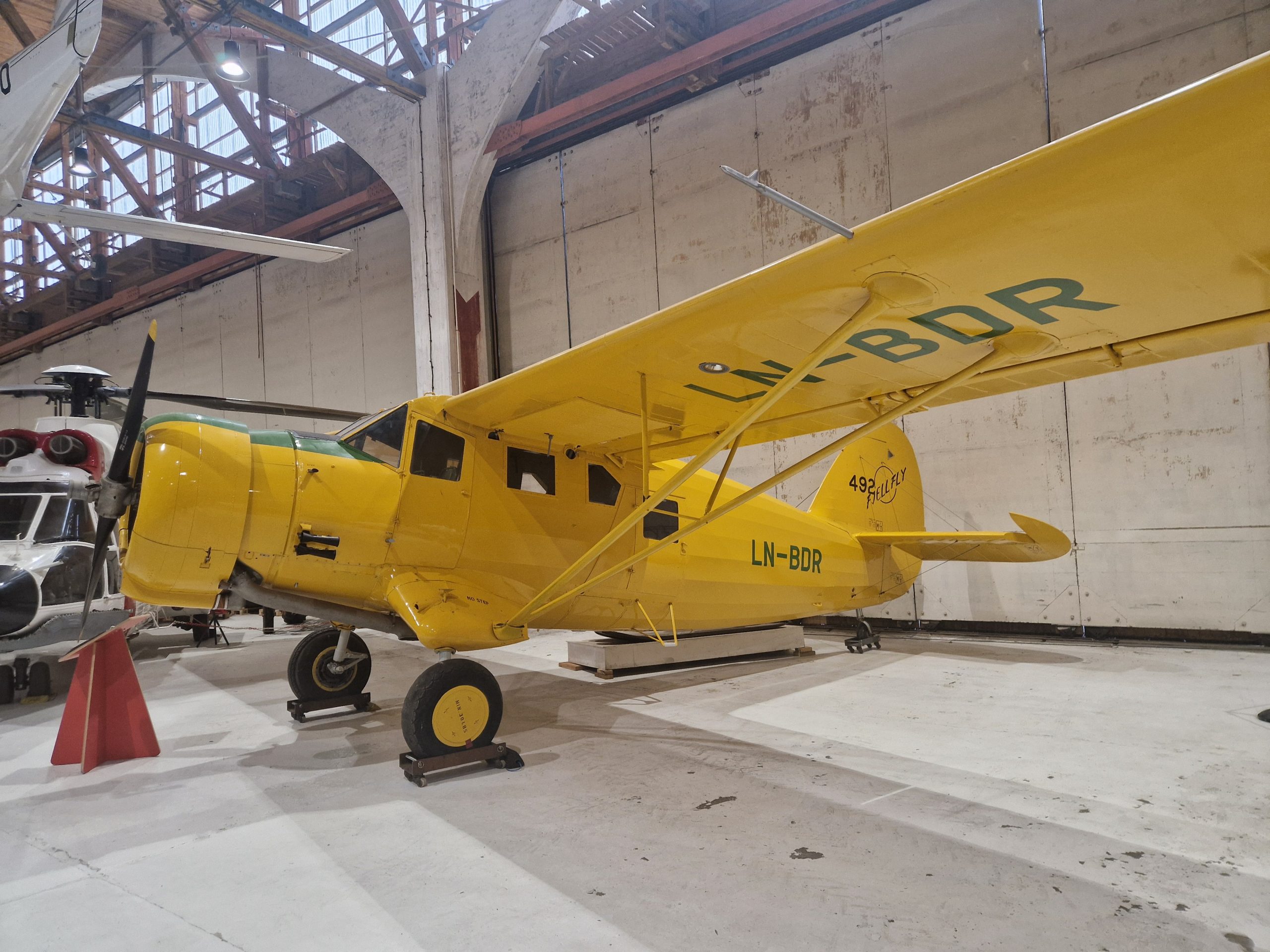
The museum’s aircraft is a Noorduyn Norseman Mk. IV with construction number 92. It was built in 1942. The aircraft served in the Royal Canadian Air Force with the registration 492 until 1953, when it was transferred to the Royal Norwegian Air Force and given the code R-AK.
In 1957, the museum’s aircraft, which had served at Sola, was sold to Fjellfly. There it flew mostly on floats and it carried the civilian registration LN-BDR. In the early 1970s, it was acquired by a Swedish operator and eventually ended up in a Swedish museum. In the autumn of 1994, it was sold to Flyhistorisk Museum Sola, which has restored it to the appearance it had when it was operated by Fjellfly.
| Type | Medium-sized transport aircraft |
| First flight | 1935 |
| Length | 10,4 m |
| Wingspan | 15,7 m |
| Height | 3,1 m |
| Weight, empty and max | 1925 / 3360 kg |
| Engine | Pratt & Whitney R-1340 |
| Engine power | 600 hp |
| Top speed | 250 km/h |
| Range | 1500 km |
| Crew | Pilot |
| Passenger capacity | 9 |
| Country of origin | Canada |
| Number used by the Armed Forces | 24 |
| Service period in the Armed Forces | 1945–1959 |
| Museum number | FMSG2011.20.01 |
| Project manager | Rasmus Svihus, Ingvar Rasmussen |
| Volunteer hours | 2201 |