
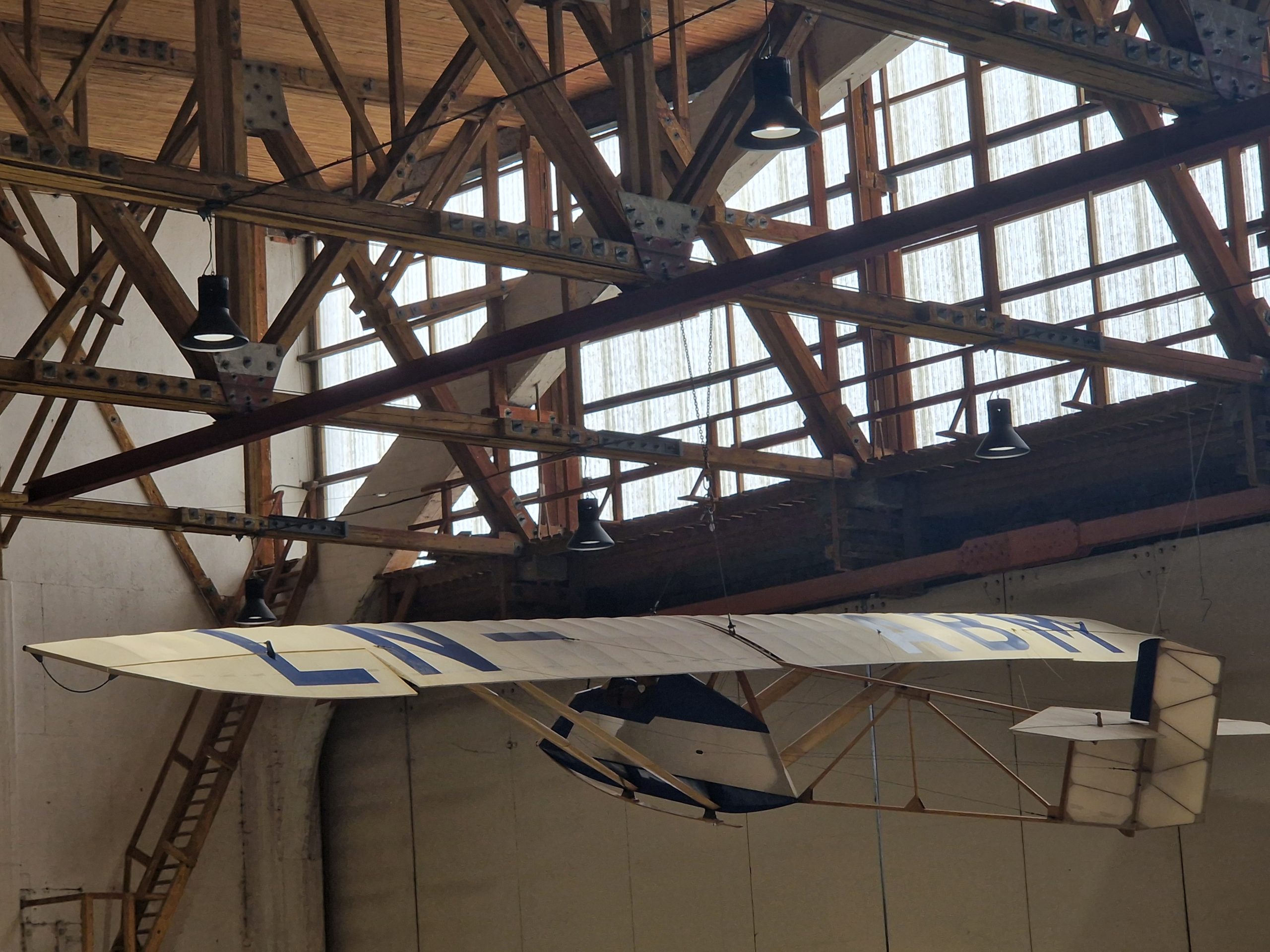
Hols der Teufel has the looks of an oversized toy aircraft and a rather silly name. Hols der Teufel is a slightly inaccurate translation of the Swedish swear phrase “djävlar anamma”, which roughly means “devil take it”. Odd names aside, the aircraft nevertheless represents an important chapter in the early development of gliders.
The aircraft was designed at Wasserkuppe in Germany in the early 1920s. Among those involved in the design work were Swedish students and interns, who were the ones to introduce the swear phrase into the project. The very first aircraft was called Djävlar Anamma. It was designed by Alexander Lippisch at Wasserkuppe in 1923.
You needed a certain amount of courage to fly this aircraft. It has no engine, and was launched by bungee-rope catapult. Before a flight, you’d have to transport the aircraft and catapult up a hill, where you’d be shot up into the air like a slingshot. If you were lucky, the flight would last for a few minutes.
In 1928, an improved version of the aircraft was introduced. It was designed by Alexander Lippisch and Hans Jacobs, and manufactured by Alexander Schleicher Flugzeugbau in the valley below Wasserkuppe. In 1932, Hans Jacobs published a book containing detailed plans for Hols der Teufel. With the book on their workbench, amateurs around the world began building their own Hols der Teufel gliders.
The museum’s aircraft
In 1933, Lars Bergo began building Norway’s first Hols der Teufel. Bergo was a member of the Norwegian aero club Aal Flyveklubb, at a time when gliding in Norway was still in its infancy. The aircraft was certified in 1934 and was given the nickname “Mehank,” the local word for mosquito. During the war, the glider was placed in storage, and was scrapped in 1953. Before being chopped up for firewood, all metal fittings were saved and later reused in a reconstruction project started by Ole Ivar Bergseidjordet. He never completed the aircraft and eventually donated the unfinished glider to Flyhistorisk Museum Sola. Tor Holgersen at Kjevik completed the aircraft. We have named the aircraft “Mehank II” and painted it in the colors of the original Mehank, as it flew for Aal Flyveklubb in the 1930s.
Hols der Teufel was the predecessor of the much better-known gliders Schneider Grunau 9 and DFS SG-38 Schulgleiter, the latter is also on display at the museum.
Spesifications
| Type | Single-seat glider |
| First flight | 1923 / 1928 |
| Length | 6,5 m |
| Wingspan | 12,6 m |
| Weight, empty and maximum | 170 / 295 kg |
| Country of origin | Germany |
| Museum number | FMSG2005.24.01 |
| Project manager | Rasmus Svihus, Ingvar Rasmussen |
| Volunteer hours | 805 |