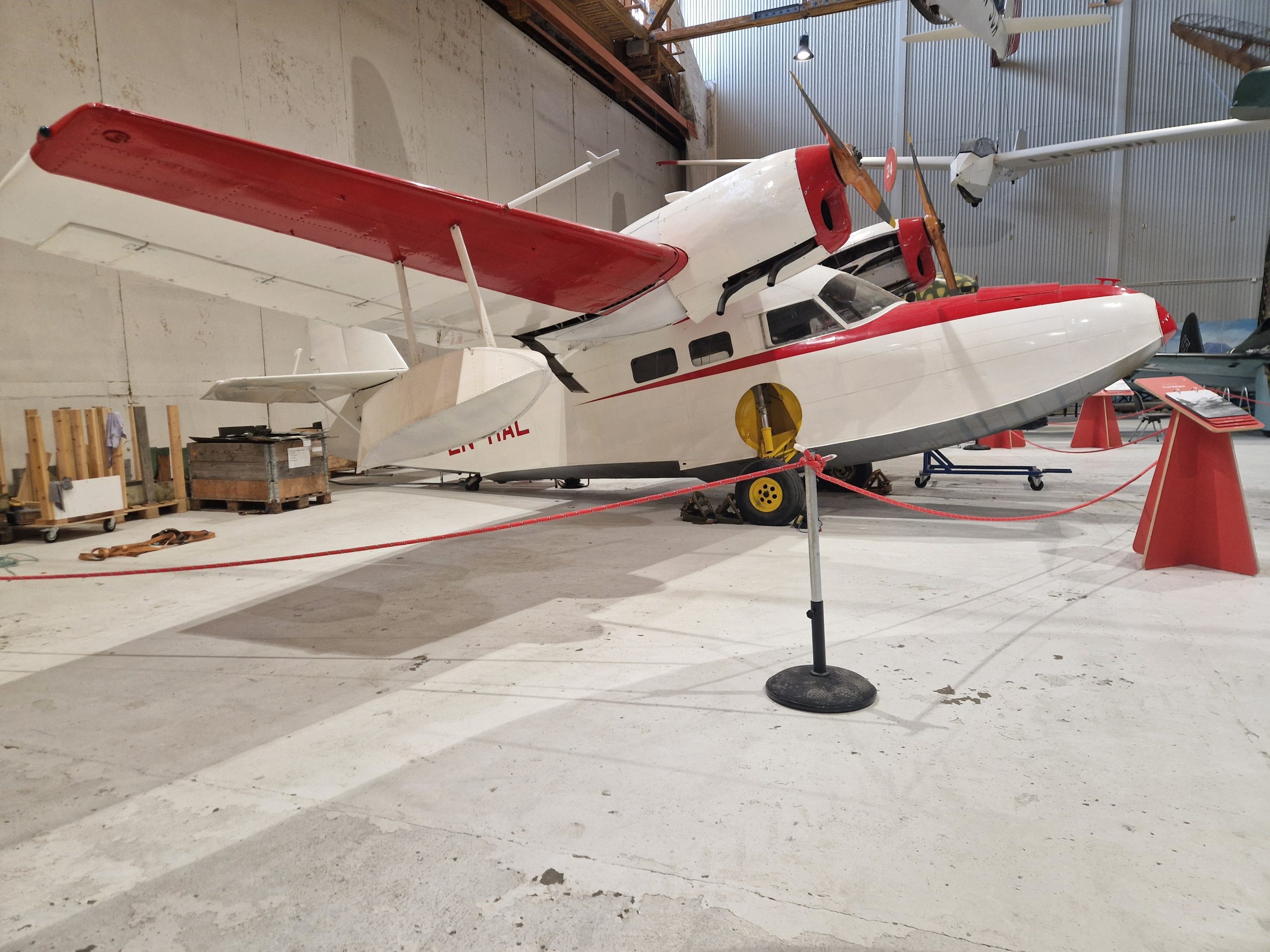
It’s hard not to smile while looking at this aircraft. It could almost have been pulled out of a comic strip.
Amphibious aircraft from the late 1930s can almost be read like books about how aeronautical engineers thought at the time. The aircraft were intended to be as versatile as possible, capable of landing both on land and on water. The Widgeon floats on its fuselage, while the wing-mounted floats provide stability if the aircraft heels to one side.
The aircraft was developed for civil aviation, but during the Second World War it was taken into service by the American and British armed forces. In these roles it flew as a patrol, observation, and transport aircraft. The aircraft was also produced under license in France.
The aircraft could withstand heavy seas and operate in fairly rough weather, which made it well suited for air ambulance duties.
The aircraft was in production from 1941 to 1949. Post-war American aircraft were designated G-44A. The hull was redesigned, and with this improvement the aircraft became easier to manoeuvre on water. It also received an additional seat, increasing capacity to six persons.
From the period before the Second World War and well into the 1950s, aircraft capable of landing on water played an important role in Norwegian aviation. As the network of airports was expanded, however, it became easier to operate land-based aircraft.
The museum’s aircraft
The museum’s aircraft was built at Grumman’s factory in Bethpage on Long Island, New York, in 1943. During the war it was operated by the US Navy and the British Royal Navy Fleet Air Arm. Later, a newspaper in Stockholm used the aircraft as a news-gathering aircraft.
In 1959 it was taken into service by the Norwegian company Mørefly A/S and received the Norwegian registration LN-HAL. Mørefly used it for air taxi and air ambulance operations, as well as for herring and tuna spotting for the fishing industry. The aircraft was also used for news flights on behalf of the newspaper Aftenposten. It was expensive to operate and was grounded after a landing accident in 1969.
When the aircraft was retired from active service, it was donated to the Norwegian Museum of Science and Technology in Oslo and later transferred to Flyhistorisk Museum Sola.
Spesifications
| Type | Amphibious aircraft |
| First flight | 1940 |
| Length | 9,5 m |
| Wingspan | 12,2 m |
| Height | 3,5 m |
| Weight, empty and maximum | 1470 / 2055 kg |
| Engines | 2x Ranger L-440-5 |
| Engine power | 2x 200 hp |
| Maximum speed | 245 km/h |
| Range | 1480 km |
| Crew | Pilot |
| Passenger capacity | 4 |
| Country of origin | USA |
| Museum number | JÆG2025.020.01 |
| Project manager | Mathias Bolgen |