
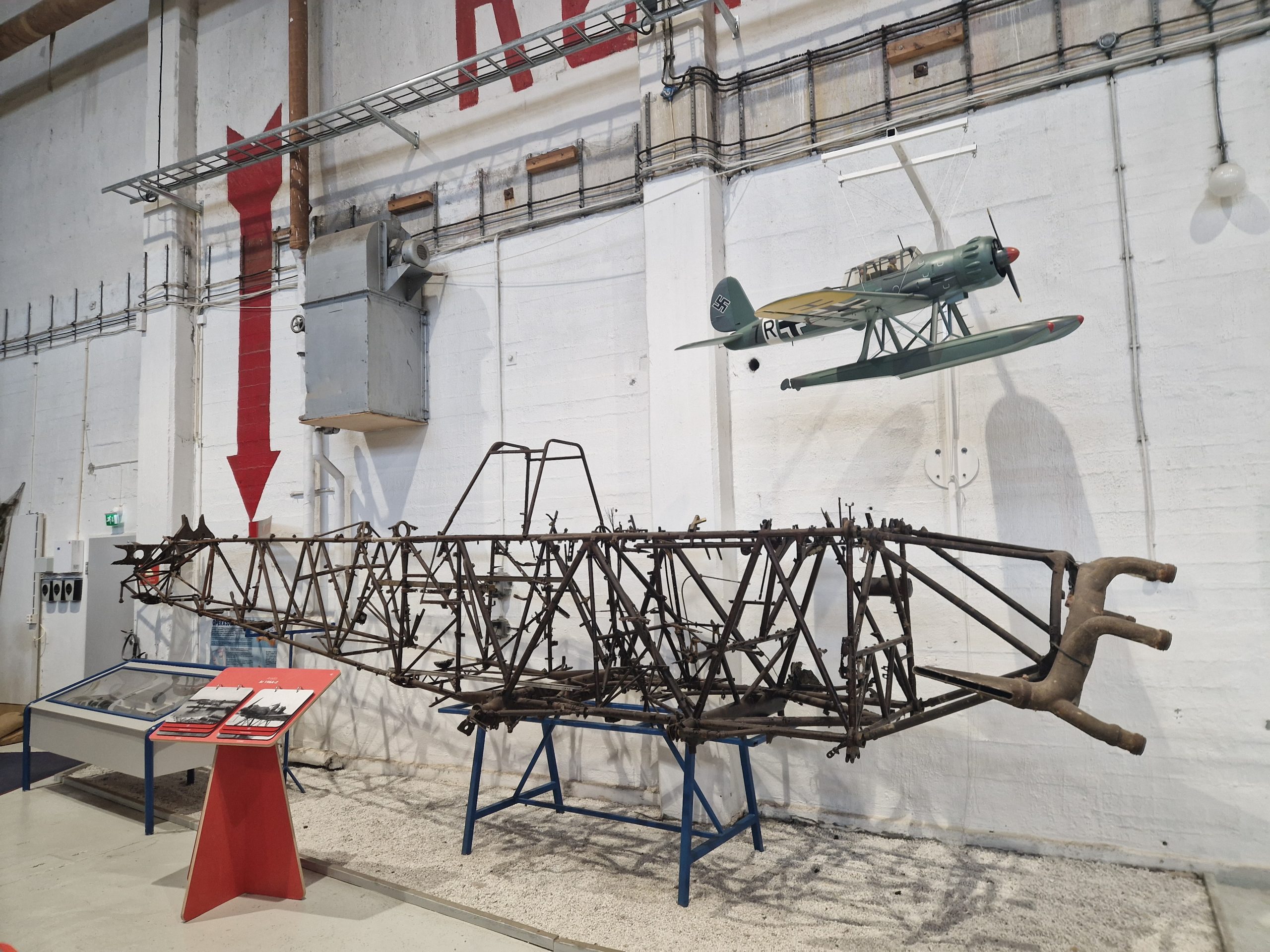
Aviation history is full of wild ideas and brave pilots. The Arado Ar 196 was built to be launched by catapult from the deck of large warships. In this way, ships could send aircraft out on reconnaissance missions. When the aircraft returned, it landed on the sea and was hoisted back on board by crane.
The aircraft you see here is what remains of one of the aircraft that stood on the deck of the cruiser Blücher, when it was sunk by Norwegian forces in the Oslofjord on 9 April 1940. Around 1000 German sailors and soldiers lost their lives.
Two Arado Ar 196 aircraft were carried on board Blücher. This aircraft was salvaged in 1994. The other still lie on the bottom of the Oslofjord together with Blücher.
The Arado Ar 196 had a large engine in the nose and a crew of two seated in tandem. The prototype first flew in June 1937, and the aircraft type was taken into service by German units towards the end of 1939. The aircraft was produced in several versions and was used by the Germans throug the entire war.
During the Second World War, large naval vessels were often designed to carry seaplanes on deck. The aircraft were used for reconnaissance but were also armed.
This aircraft had two 20 mm cannon in the wings. In the fuselage there were two 7,92 mm machine guns, one firing forward and one rearward. The aircraft could carry a bomb load of 50 kg under each wing. The type was also used as a patrol aircraft and for convoy escort from seaplane bases along the coast.
Norwegian service
Two aircraft of this type were used by Norwegian forces. The first was an aircraft that made an emergency landing near Kristiansund on 8 April 1940. The aircraft belonged to the German cruiser Admiral Hipper. The day before the outbreak of the war, the aircraft was on a reconnaissance mission but ran out of fuel and had to make an emergency landing. The crew was interned and the aircraft confiscated.
In 1943, a similar aircraft was taken into custody by the Swedish neutrality guard. The crew was returned to Germany, while the aircraft was stored and later sold for civilian use in Sweden. The aircraft eventually came into the hands of a business controlled by British intelligence. After the war, the aircraft was used for a short period by 333 Squadron here at Sola Seaplane Base.
Spesifications
| Type | Two-seater maritime reconnaissance aircraft |
| First flight | 1937 |
| Length | 11 m |
| Wingspan | 12,4 m |
| Height | 4,5 m |
| Weight, empty and max | 2990 / 3720 kg |
| Engine | BMW 312K |
| Engine power | 960 hp |
| Maximum speed | 310 km/h |
| Range | 1050 km |
| Armament | 2x 20 mm cannons, 2x 7,92 mm machine guns, 2x 50 kg bombs |
| Country of origin | Germany |
| Museum number | FMSG2025.005.01 |