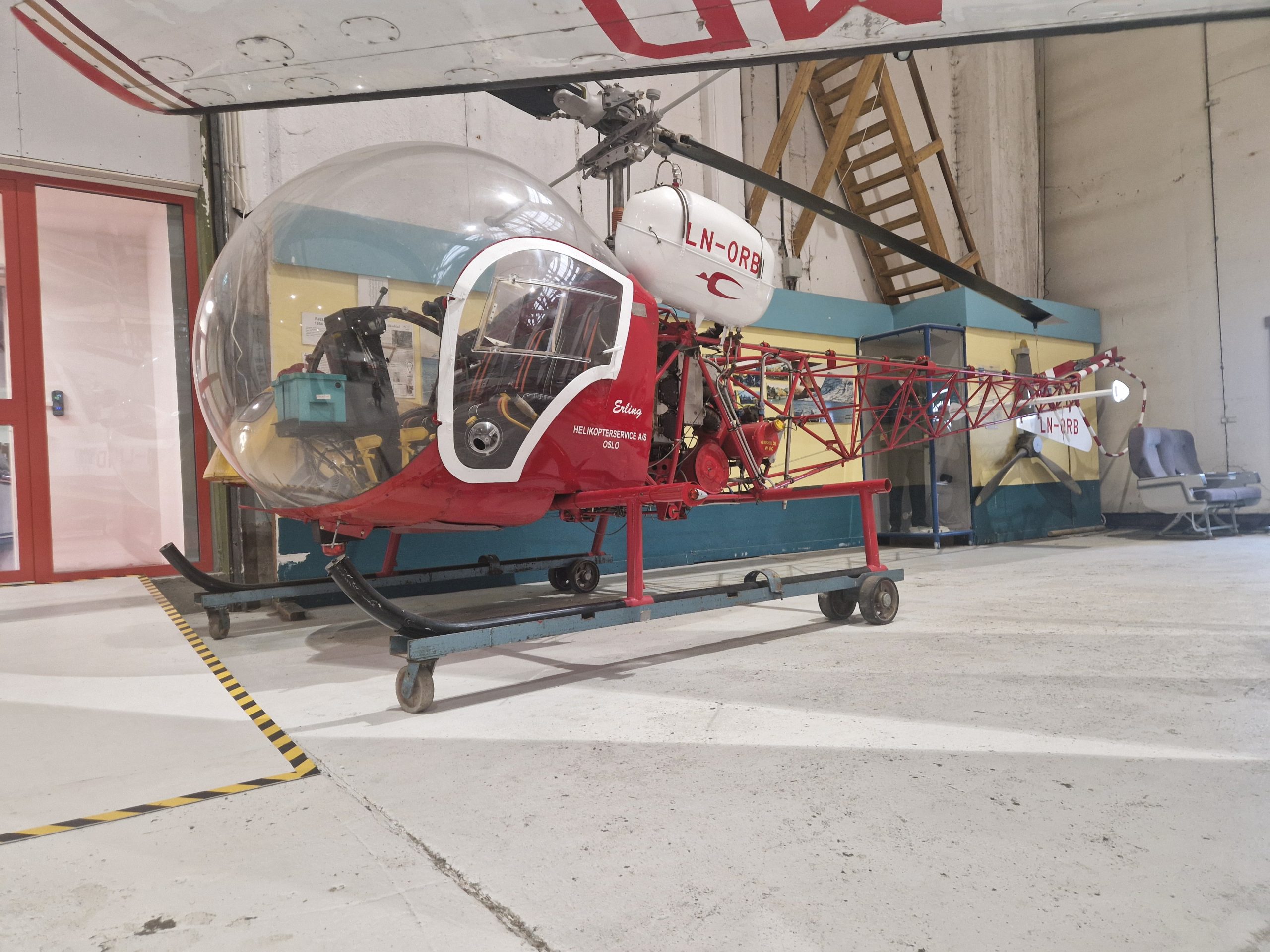
The Bell 47 is one of the world’s most successful helicopters. It was produced in countless variants and used all over the world. The little helicopter took over much of the transport work that light aircraft had previously carried out. It also took on missions where fixed-wing aircraft could not be used, as it can land almost anywhere. The civilian version of the helicopter has seating for two passengers, in addition to the pilot, who sits in the middle.
During the Korean War (1950–1953), the helicopter truly demonstrated how useful it could be. It distinguished itself in particular by evacuating wounded soldiers from the battlefield to field hospitals. The patients were carried on stretchers mounted on the helicopter’s skid struts. The prototype of the Bell 47 flew for the first time in December 1945. At least 5600 helicopters were produced.
Norwegian service
In Norway, the Bell 47 was introduced in the early 1950s. This was a period when the Royal Norwegian Air Force was expanding and suffered a very high number of aircraft accidents. The same was true in several other countries. In the United Kingdom and the United States, helicopters had already taken over much of the search-and-rescue and air ambulance work. The Royal Norwegian Air Force also adopted the helicopter for these roles. The first Bell 47 helicopters arrived in Norway in 1953, at the same time as the first Norwegian helicopter pilots completed their training.
In addition to the military rescue service for fighter pilots, the helicopters were used for civilian air ambulance operations. They were too small and underpowered to be equipped with a rescue hoist, had limited lifting capacity, and short range. Even so, the Norwegian Armed Forces used the Bell 47 until 1971. The last military helicopter of this type to be withdrawn from service had, since April 1953, logged 7177 flight hours.
The museum’s aircraft
The Bell 47 was also used by several civilian helicopter companies. The companies that used it most extensively in Norway were Helikopter Service, Mørefly, and Helilift. The museum’s helicopter is a Bell 47G that was license-built in England by Westland Aircraft in 1967. It began its service in Yemen, where it was used in combat against insurgent forces. Later, the helicopter was sold to Sweden, where it was used by commercial operators until 21 August 1982. On that day, it crashed shortly after take-off from Adolfsström in northern Sweden. The helicopter failed to generate sufficient lift and was forced to make an emergency landing on Lake Iraft. One of the passengers drowned. The pilot and the other passenger escaped without serious injuries.
In 1995, it was purchased by Helikopter Service and donated to Flyhistorisk Museum Sola. It has been restored to represent one of the Bell 47 helicopters operated by Helikopter Service.
| Type | Three-seat helicopter |
| First flight | 1945 |
| Length | 8,3 m |
| Rotor diameter | 10,7 m |
| Height | 2,8 m |
| Weight, empty and max | 626 / 944 kg |
| Engine | Franklin 6V4-200-C-32 |
| Power output | 200 hp |
| Top speed | 170 km/h |
| Range | 411 km |
| Crew | 1 / 2 (1x pilot / 1x pilot, 1x mechanic) |
| Passenger capacity | 1 / 2 |
| Country of origin | USA |
| Number used by the Armed Forces (all versions) | 14 |
| Service life in the Armed Forces | 1953–1971 |
| Museum number | FMSG2011.29.01 |
| Project manager | Gordon Bore |
| Volunteer hours | 500 |