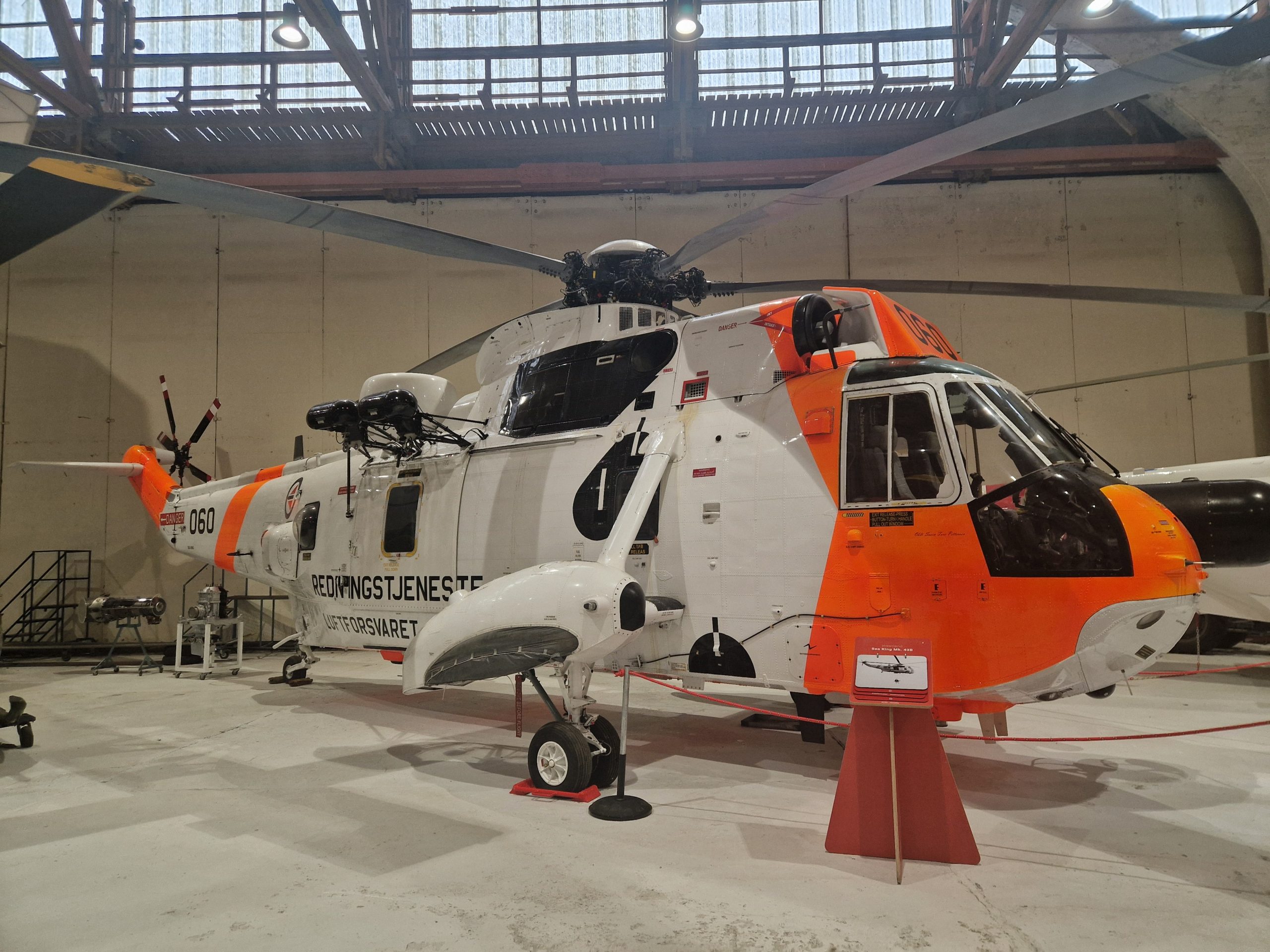
For a person in distress at sea, the sound of an approaching rescue helicopter must be among the most powerful experiences imaginable. The helicopter is a flying symbol of how we humans take care of each other. The Norwegian Sea King were in operational service from 1973 to 2023. The helicopter had a crew of six, including a doctor and a rescue swimmer. The main task of the Sea King was search and rescue.
By the time the last Sea Kings were retired in 2023, they had completed 47 751 rescue and ambulance missions over 50 years. The white helicopter with an orange nose and thick orange stripes on the fuselage serves as a reminder of 50 years of safety.
The Westland Sea King is a British licensed production of the American Sikorsky S-61, developed in the mid-1950s. It was developed as an anti-submarine-warfare helicopter for the US Navy. The military designation was Sikorsky SH-3 Sea King. The civilian version was particularly popular among Norwegian and British helicopter operators servicing North Sea oil installations.
In Norway, the type gained recognition as a rescue helicopter after a giant wave smashed the stern door of the passenger and car ferry MF Skagerak in the autumn of 1966. The ferry was 40 nautical miles northwest of Hirtshals and taking on water. At the time, Denmark had recently started using the Sikorsky S-61 in their search and rescue service. Five Danish S-61s participated in the rescue operation and hoisted 69 people; the rest were rescued by boats. Following the accident, plans for Norwegian rescue helicopters were developed, and ten Westland Sea King Mk. 43 were ordered. Later, an additional five helicopters were purchased.
The Norwegian Sea Kings were formally owned by the Ministry of Justice, while the Ministry of Defence managed operations. In May 1973, the first helicopters from 330 Squadron went on standby at Sola and Bodø.
In August of the same year, Sea Kings also went on standby at Ørland and Banak. In 2006, readiness was strengthened with Sea King stationed at Rygge. The helicopter crew consisted of a pilot who was the captain, a co-pilot, a system operator, a flight engineer, a rescue swimmer, and a doctor. Initially, the helicopters were on one-hour standby, but this was later reduced to 15 minutes, meaning the crew had to stay near the helicopter around the clock.
The museum’s aircraft
The museum’s helicopter carries tail number 060. This was the first Sea King produced for Norway. Its very first flight was on 19 May 1972. The helicopter participated in the rescue efforts after the Alexander Kielland platform capsized on the Ekofisk field in March 1980. It was also involved in the MS Sleipner grounding near Ryvarden lighthouse in Sveio in November 1999. By the time it was retired in June 2022, it had a total flight time of 17 945 hours.
Spesifications
| Type | Rescue helicopter |
| First flight | 1969 |
| Length | 17 m |
| Rotor diameter | 19 m |
| Height | 5,1 m |
| Weight, empty and max | 6370 / 9500 kg |
| Engine | 2x Rolls Royce Gnome H1400 |
| Engine power | 2x 1660 hk |
| Top speed | 220 km/h |
| Range | 1200 km |
| Crew | 2x pilot, 1x system operator, 1x flight engineer, 1x rescue swimmer, 1x doctor |
| Passenger capacity | 18 |
| Country of origin | United Kingdom |
| Number used by Norwegian Armed Forces | 15 |
| Service period | 1972 – 2023 |
| Museum number | JÆG2025.021.01 |