
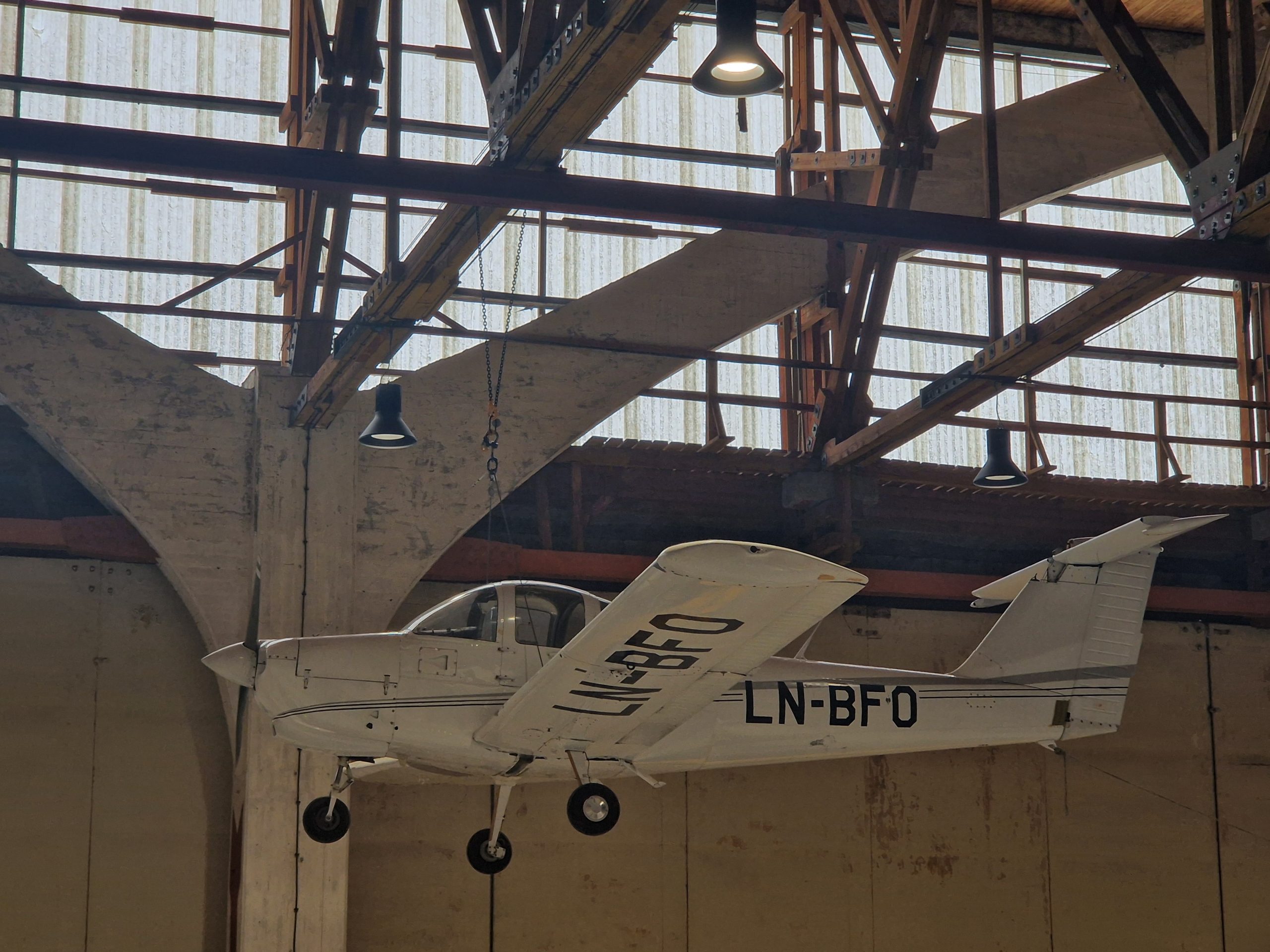
The Piper PA-38 Tomahawk was developed in response to a survey conducted in 1972. What would be the ideal training aircraft? The question was posed by Piper Aircraft Corporation. 4000 flight instructors responded. The American manufacturer wanted to create an affordable aircraft that could, among other things, be put into a spin to teach civilian student pilots how to recover from such an emergency. A spin occurs when the aircraft suddenly loses lift and falls toward the ground in an uncontrolled rotational motion. The result was this low-wing aircraft with fixed landing gear and a distinctive T-shaped tail.
The plane has seating for two people side by side. It was designed as a training aircraft, but it also became a popular recreational aircraft.
The prototype first flew in 1973, but series production did not begin until 1978. By then, over 1400 aircraft had been ordered. Production continued until 1983, with approximately 2200 aircraft built.
The Tomahawk was considered a good trainer. It had excellent visibility, wide main gear spacing, a well-arranged instrument panel, and plenty of space in the cockpit. At the same time, there were some aspects that were less than optimal. Its low-speed handling was poor. If the aircraft flew with the nose slightly too high at too low a speed, it would quickly lose altitude and could enter an unintended spin.
The goal of making the aircraft affordable did not fully succeed in the long run. After 1000 flight hours, the engine mount had to be replaced to prevent a likely nosewheel failure. After 10 000 hours, the Norwegian aircraft were withdrawn from service. Continuing to fly them would have required, among other things, upgrading the wings—a cost that would have exceeded the aircraft’s value.
The muesum’s aircraft
The museum aircraft was imported by Nyge-Aero AS at Fornebu in May 1979. A few years later, it was sold to Ascor Flyservice AS, which in 1984 sold it to the aero club Helikopter Service Flyklubb at Sola. In 1997, the aircraft suffered a landing accident at Kjevik. It was repaired and returned to service with Sola Flyklubb. During takeoff in the summer of 1999, the aircraft was blown off the runway. It suffered extensive damage and has never flown again.
Spesifications
| Type | Two-seat light aircraft |
| First flight | 1977 |
| Length | 7 m |
| Wingspan | 10,4 m |
| Height | 2,8 m |
| Weight, empty and max | 512 / 757 kg |
| Engine | Lycoming O-235 |
| Engine output | 112 hp |
| Top speed | 200 km/h |
| Range | 870 km |
| Country of origin | USA |
| Museum number | FMSG2025.009.01 |