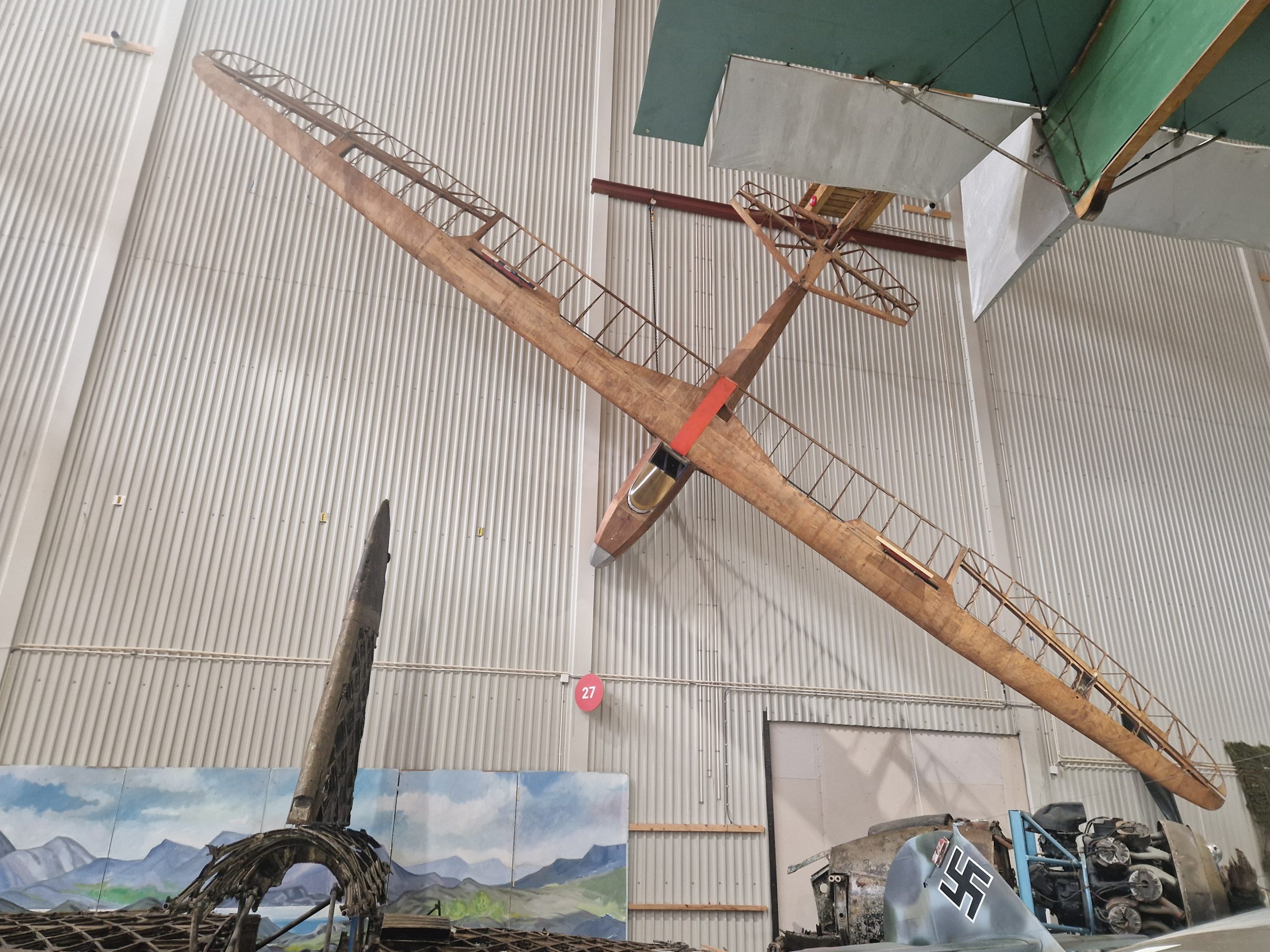
The sailplane is partially restored. Fabric covering is missing, and you can see how the wings are constructed like a skeleton to keep it as lightweight as possible. The aircraft was developed by the German aircraft designer Edmund Schneider. He founded Segelflugzeugbau Edmund Schneider in 1928. In 1933, the sailplane Schneider Grunau Baby set an endurance record over East Prussia. The flight lasted 26 hours and 36 minutes.
The Schneider Grunau Baby is the most widely produced sailplane in aviation history. It was manufactured in more than 20 countries, with at least 6000 aircraft produced across various versions. In addition to licensed production, the aircraft was also built by amateurs from kit sets.
The museum’s aircraft
The museum’s aircraft is a British-built EoN Baby Type 8, produced by Elliot of Newbury Ltd in England. The aircraft manufacturer was originally a furniture factory that also made sailplanes during and after the war.
The museum’s aircraft is an improved version of the Schneider Grunau Baby 2b. The most noticeable difference is the enclosed cockpit, which is slightly more spacious than the original.
Construction of the aircraft began in 1948 and was completed in 1950. It was purchased by the Norwegian aero club Norsk Aero Klubb (NAK). In 1960, it was used by the Norwegian aero clubs Valdres and Oslo Flyklubb. In 1962, it was sold to Bodø Flyklubb, where it flew until the certificate of airworthiness expired in 1964. Bardufoss Flyklubb took over the aircraft in 1969, but it was never made airworthy again. In May 1978, it was donated to the historical society Norsk Flyhistorisk Forening, which passed it on to the Flyhistorisk Museum Sola in 1992.
Spesifications
| Type | Single-seater sailplane |
| First flight (Schneider Grunau Baby) | 1931 |
| Length | 6,3 m |
| Wingspan | 13,6 m |
| Height | 1,5 m |
| Weight, empty and max | 170 / 250 kg |
| Top speed | 150 km/h |
| Country of origin | Germany / United Kingdom |
| Museum number | FMSG2011.21.01 |