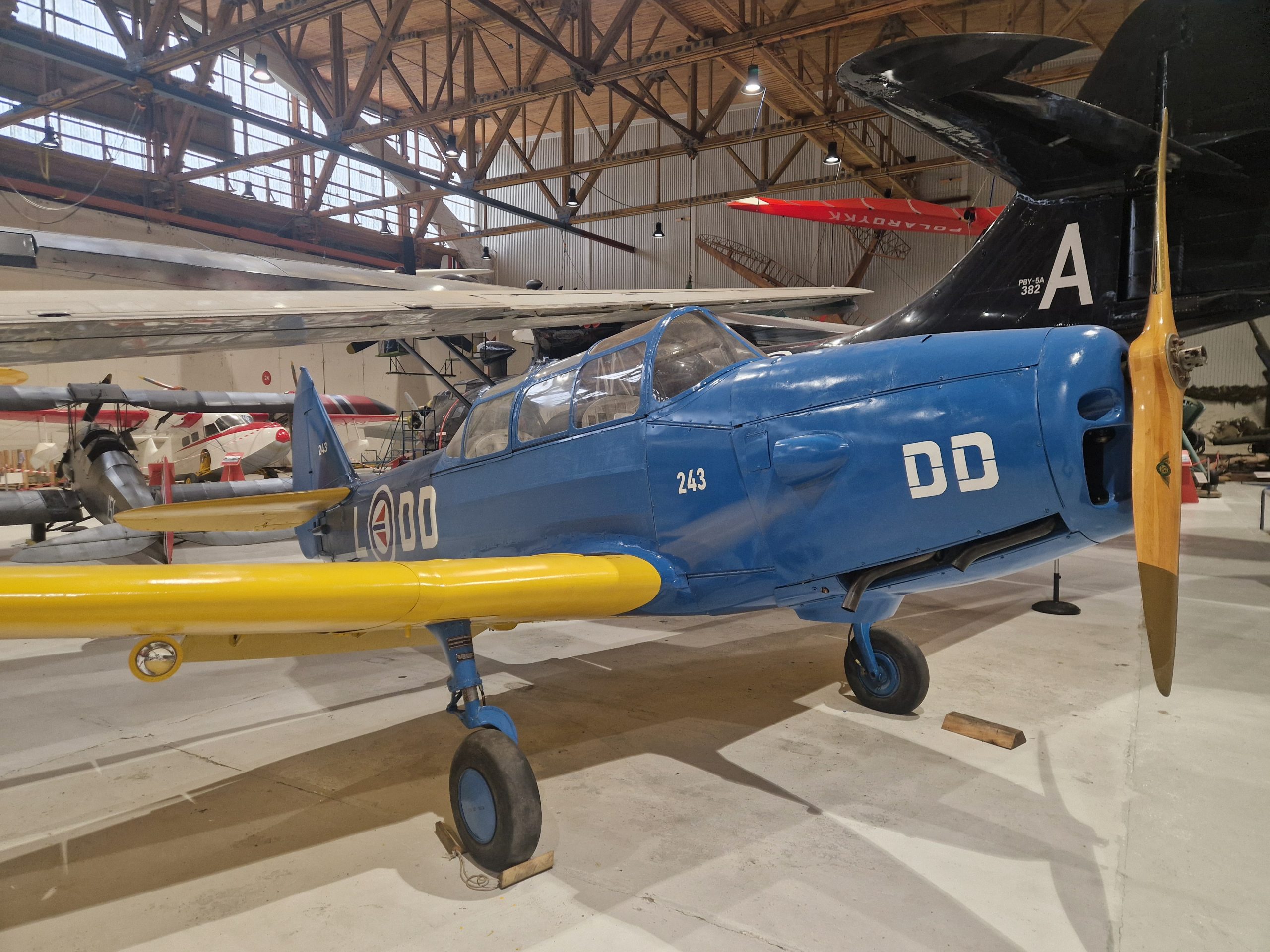
This aircraft has two of everything needed to pilot it. It can therefore be controlled equally well from the front seat as the back seat. Usually, the student would sit in the front seat, with the instructor seated behind them.
The Fairchild PT-26 Cornell is an American aircraft introduced at military flight schools in 1939. Norwegian pilots who were trained during the war at Little Norway in Canada flew this type of aircraft. After the war, the aircraft were used at the flight school of the Royal Norwegian Air Force located at Værnes since the early 1950s.
The fuselage is made of steel tubing and fabric. The propeller is made of wood, as are the wings.
The engine produces 200 hp. The Royal Norwegian Air Force stopped using the aircraft in 1956. Many of them were then sold to flying clubs.
The aircraft was developed by the American aircraft manufacturer Fairchild Aircraft and was built as a training aircraft for the United States Army Air Corps. The early version had an open cockpit. During the war, the aircraft was continuously improved and it received new designations.
Norwegian service
During the war, a Norwegian flight school was established outside Toronto in Canada. The school became known as Little Norway. The first training aircraft were six Fairchild M-62 Cornell. The students received 100 flight hours in the Fairchild Cornell before moving on to fighter aircraft or larger multi-engine aircraft. At the turn of the year 1944/45, the Norwegian flight school was moved to Winkleigh in southern England.
During the war years, the flight school received a total of 86 Fairchild Cornell of various models: PT-19, PT-19A, and PT-26. The PT-19A was the first to have a closedcockpit. The first aircraft of this type arrived in Norway in November 1945 and were used at the military flight school then located at Gardermoen.
After Norway joined NATO in 1949, pilot training was moved from Gardermoen to the USA and Canada. In Norway, only selection flying was conducted. The students received 20–25 flight hours during which they were evaluated as candidates for pilot training abroad. The Fairchild Cornell was used as a military training aircraft until the Saab 91B-2 Safir took over in the autumn of 1956.
The museum’s aircraft
The museum’s aircraft arrived at Little Norway in Canada in late summer 1944. At the turn of the year 1944/45, the Norwegian flight school and its aircraft were moved to England. In the autumn of 1945, the aircraft, together with the other aircraft of the flight school, was transferred to Norway. It was then taken into use by the military flight school at Gardermoen. In the early 1950s, the school was moved to Værnes, and the museum’s aircraft followed. In 1961, the Norwegian aero club Ullensaker Flyklubb took over the aircraft. It was grounded in 1963. Flyhistorisk Museum Sola took over the aircraft from the Norwegian Armed Forces Museum in the early 1990s. During the restoration, parts of the aircraft had to be rebuilt from scratch, including the wings, which are mainly made of plywood and fabric. Many parts were taken from other aircraft.
Spesifications
| Type | Two-seater military training aircraft |
| First flight | 1939 |
| Length | 8,5 m |
| Wingspan | 11 m |
| Height | 2,3 m |
| Weight, empty and maximum | 920 / 1270 kg |
| Engine | Fairchild Ranger L-440-3 |
| Engine power | 200 hp |
| Maximum speed | 230 km/h |
| Range | 690 km |
| Armament | None |
| Country of origin | USA |
| Number used by the Armed Forces | 86 |
| Service period in the Armed Forces | 1940–1957 |
| Museum number | FMSG2025.004.01 |
| Project manager | Siegfried Hernes, Harald Egge |
| Volunteer hours, per 2025 | 1747 |