
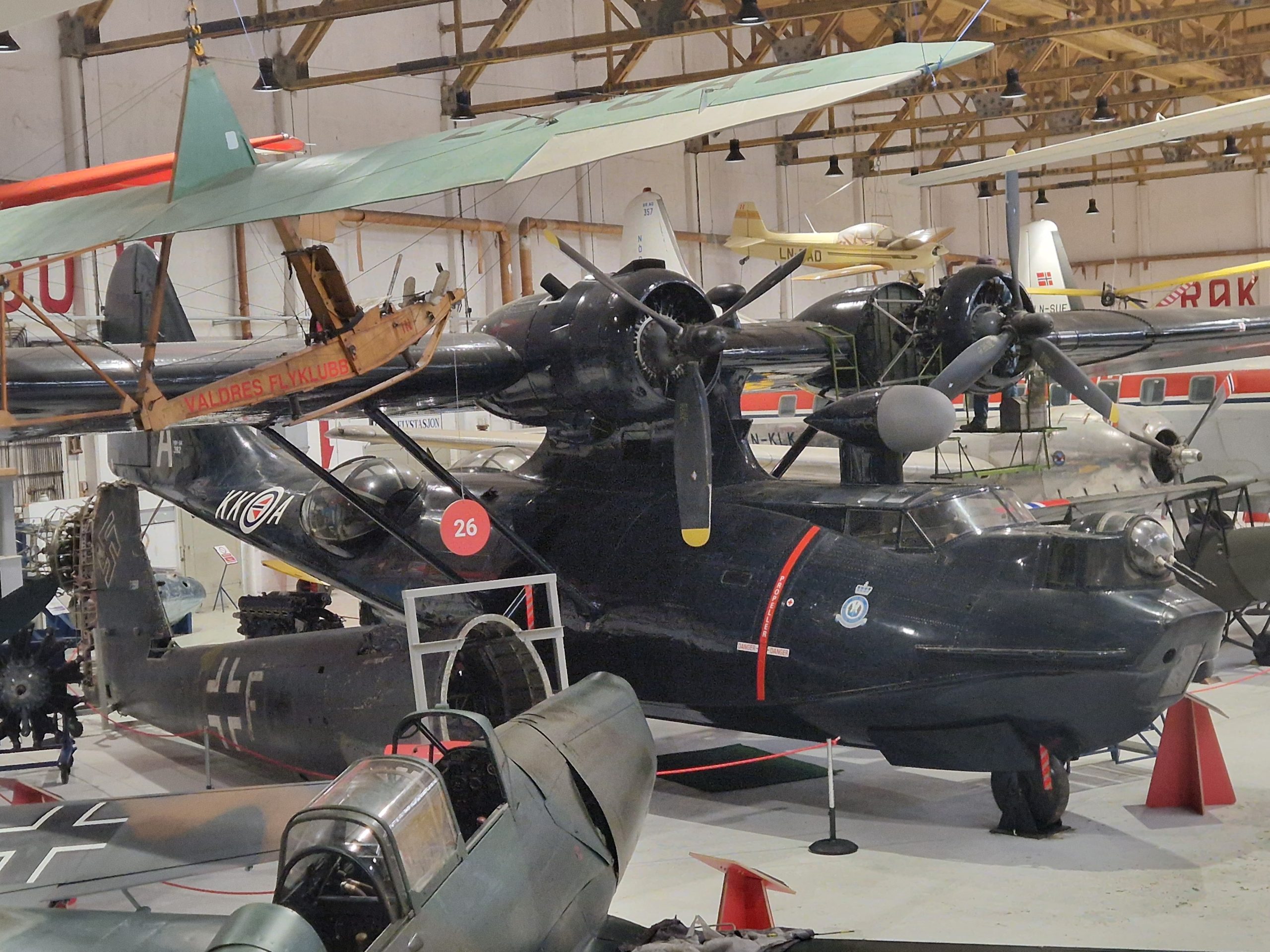
The Catalina had enormous capacity. It could remain airborne for more than 20 hours at a time and was equally capable of landing on water as on land. The aircraft was designed as a long-range maritime patrol bomber, intended to cover vast ocean areas. However, it was vulnerable if the enemy appeared. It had poor manoeuvrability, a cruise speed of around 200 km/h, and often flew missions alone. At the same time, the aircraft possessed capabilities that most others lacked. It was used for surveillance and sea rescue, transported agents into enemy territory, and was an important aircraft for escorting ship convoys in the North Atlantic.
The Catalina was produced from 1936 to 1945, with more than 3000 aircraft built. It is the most widely produced flying boat in the world.
During the Second World War, several Norwegian squadrons were established abroad. Two of these squadrons were equipped with Catalinas, crewed by Norwegian personnel. The local knowledge of the Norwegian pilots was extremely important, especially when flying agents and equipment in and out of German-occupied Norway. The aircraft also carried out reconnaissance missions and attacks against German ships and submarines off the Norwegian coast.
After the war, Catalinas were based with 333 Squadron here at Sola Seaplane Base. They remained in service until the early 1960s. During this period, the Soviet Union carried out extensive military expansions on the Kola Peninsula. To monitor Soviet activity, Norway received six PBY-5A Catalina aircraft from the United States as replacements for the older Catalinas in 1953/54. The aircraft on display here is of the same type. In addition to surveillance duties, the aircraft transported mail and supplies to Norwegian stations on Svalbard, Bjørnøya, and Hopen. They were also used for search and rescue, minesweeping, herring spotting, and transport missions.
The museum’s aircraft
The museum’s Catalina was built by Convair in San Diego in 1942. During its early years, it was stationed at various U.S. Navy bases on the west coast of the United States. It was later placed in storage in the Arizona desert, where it remained until 1951, when it was transferred to Denmark as part of the Mutual Defense Assistance Program. For a period, the aircraft was stationed in Greenland, where it conducted ice patrols and took part in search and rescue operations, and scientific expeditions. Its final flight took place on 14 October 1967. In 1982, it was sold to a private individual and placed behind an outbuilding in Plejerup, Denmark. The aircraft was in very poor condition when Flyhistorisk Museum Sola acquired it in the autumn of 1989. After many thousands of volunteer hours, the aircraft has become one of the museum’s greatest treasures.
Spesifications
| Type | Maritime patrol aircraft |
| First flight | 1935 |
| Length | 31,7 m |
| Wingspan | 19,5 m |
| Height | 6,4 m |
| Weight, empty and max | 7950 / 15 400 kg |
| Engine | 2x Pratt & Whitney R-1830 |
| Power | 2x 1200 hp |
| Top speed | 315 km/h |
| Range | 4800 km |
| Crew | 7 |
| Armament | 3x 7,62 mm machine guns, 2x 12,7 mm heavy machine guns, 1800 kg bomb load |
| Country of origin | USA |
| Number used by the Armed Forces (all versions) | 40 |
| Service life in the Armed Forces | 1942–1961 |
| Museum number | FMSG2011.22.01 |
| Project leader | Gunnulv Løge |
| Volunteer hours | 14 801 |