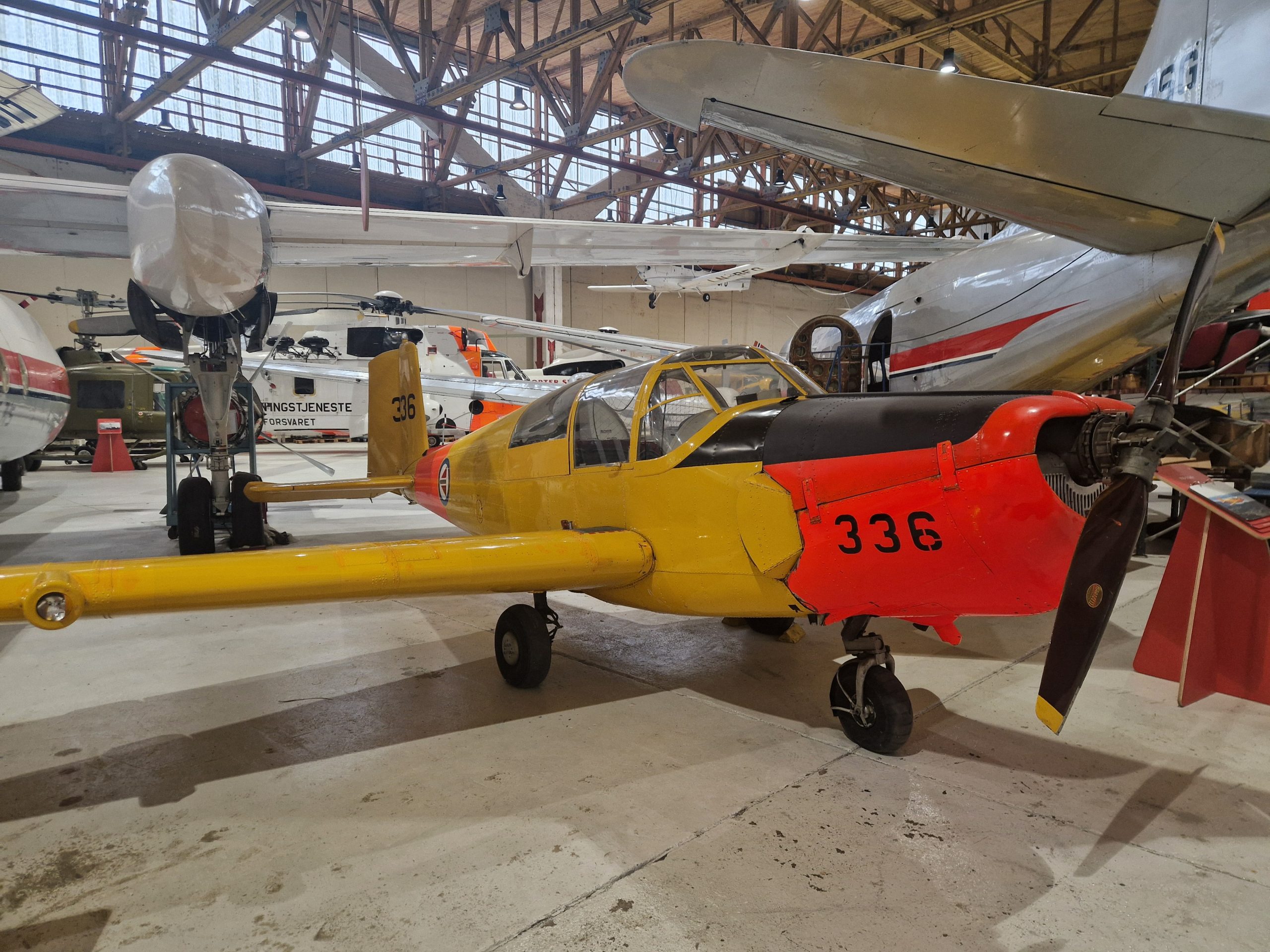
A whole generation of Norwegian pilots had their very first flight lessons in a Saab 91B-2 Safir. The aircraft was used by the military flight school for selection flights. The selection flights were part of the selection process applicants had to go through to become pilots. The best candidates were offered a place at a flight schools in USA or Canada.
The Saab Safir was developed in the mid-1940s by the Swedish aircraft designer Anders Johan Andersson.
Anders Johan Andersson started as a designer at Svenska Aero AB in the early 1920s. The aircraft manufacturer was owned by Carl Clemens Bücker. Bücker came from Germany and had moved to Sweden after Germany was prohibited from producing aircraft following the First World War. The Allies feared that Germany would rearm. That is exactly what they did, and in the 1930s Bücker returned to Germany and founded Bücker-Flugzeugbau GmbH. Andersson joined as chief designer. The factory specialized in training aircraft.
When the war broke out in 1939, Andersson returned to Sweden. He got a job at Saab AB, where they produced the Bücker Bü 181 Bestmann under license. This was an aircraft Andersson knew very well from the factory in Germany. The Saab Safir is inspired by the Bücker Bü 181.
Norwegian service
The Saab Safir was built in several versions and adapted for both civilian and military users. In the mid-1950s, Norwegian authorities purchased 25 Saab 91B-2 Safir. In addition to its use as a military training aircraft, the aircraft were also used as communication planes at various units.
The military flight school, based at Værnes, was the largest user of the type in Norway. All Norwegian military pilots were trained in the USA and Canada, but to be assessed for admission, candidates had 20–25 hours in a Saab Safir.
In Norway the Saab Safir remained in use as a military training aircraft until 1982, when it was replaced by the Saab MFI-15 Safari.
The museum’s aircraft
The museum’s aircraft has serial number 336 and was delivered to the Royal Norwegian Air Force in 1957 with the registration U-AQ. Most of the time it was used at the military flight school at Værnes. It was retired from active service in June 1982 and given to Sogn Upper Secondary School in Oslo. In 1993, it was donated to Flyhistorisk Museum Sola.
Spesifications
| Type | Three-seat military training aircraft |
| First flight | 1945 |
| Length | 7,9 m |
| Wingspan | 10,6 m |
| Height | 2,2 m |
| Weigth, empty and max | 730 / 1215 kg |
| Engine | Lycoming O-435A |
| Engine power | 190 hp |
| Maximum speed | 275 km/h |
| Range | 1050 km |
| Armament | None |
| Country of origin | Sweden |
| Number used by the Armed Forces | 30 |
| Service period in the Armed Forced | 1956–1982 |
| Museum number | FMSG2011.26.01 |