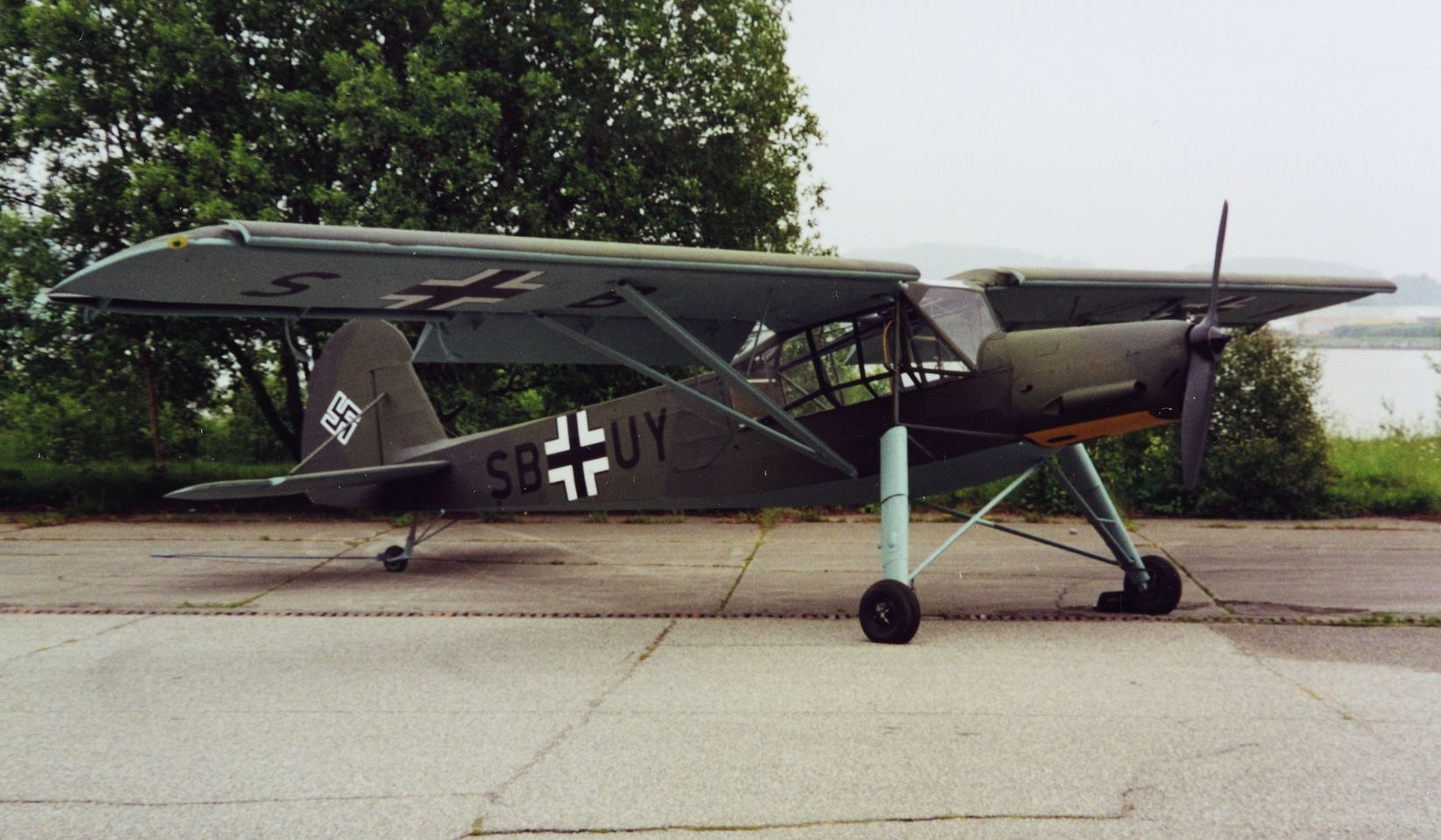
The aircraft was designed to land and take off from the most unlikely locations. Its large wings give the small and lightweight aircraft enormous lift. The long landing gir legs provide excellent shock absorption. The landing gir resembles the legs of a stork coming in to land. This “stork” is built of steel tubing and fabric and can fly as slowly as 50 km/h.
In light headwinds, the aircraft can land within a distance of just 18 metres, which is shorter than the width of this building. Under optimal conditions, it can take off again within 45 metres.
The aircraft was developed in Germany during the 1930s. It was equipped with a 240 hp engine and had a top speed of 175 km/h. The wings can be folded, making the aircraft easier to transport on the back of a truck.
The aircraft was designed to be simple to operate and became very popular during the war. It was mainly used for missions that today would typically be carried out by helicopters. These included transporting personnel and supplies between frontline units and the rear, observation flights, artillery spotting, ambulance missions, VIP transport, rescue missions and cable laying. Many German generals were assigned their own aircraft, which they used to travel between units along the front line. With this simple aircraft, they could also observe the front line or fly to meetings at field headquarters.
It was this type of aircraft that Reichskommissar Josef Terboven was seated in during the search for the heavy water saboteurs on Hardangervidda in 1943.
The aircraft rolled as it landed on Langesjøen on 24 March 1943. Everyone survived, and after a while they were rescued by another Storch.
After the war, at least 55 aircraft of this type remained in Norway. Some were repaired and put into service with the Norwegian Armed Forces, while the rest were sent to Allied surplus depots on the continent. A few were later taken over by flying clubs. The last of these aircraft was removed from the civilian register in the summer of 1962. In addition to German production, the aircraft was also produced in Czechoslovakia and France after the war.
The museum’s aircraft
The aircraft on display appears identical to the one in which Terboven was seated. In reality, it is assembled from parts taken from several different aircraft. It has been restored to a German C-2 model configuration and is equipped with a rear-facing MG 15 machine gun.
Spesifications
| Type | Two-seat liaison aircraft |
| First flight | 1936 |
| Length | 9,9 m |
| Wingspan | 14,3 m |
| Height | 3,1 m |
| Weight, empty and max | 930 / 1320 kg |
| Engine | Argus As 10C |
| Engine output | 240 hp |
| Top speed | 175 km/h |
| Range | 330 km |
| Armament | 7,92 mm machine gun |
| Country of origin | Germany |
| Museum number | FMSG2011.30.01 |
| Project leader | Kåre Andersen |
| Volunteer hours | 6875 |