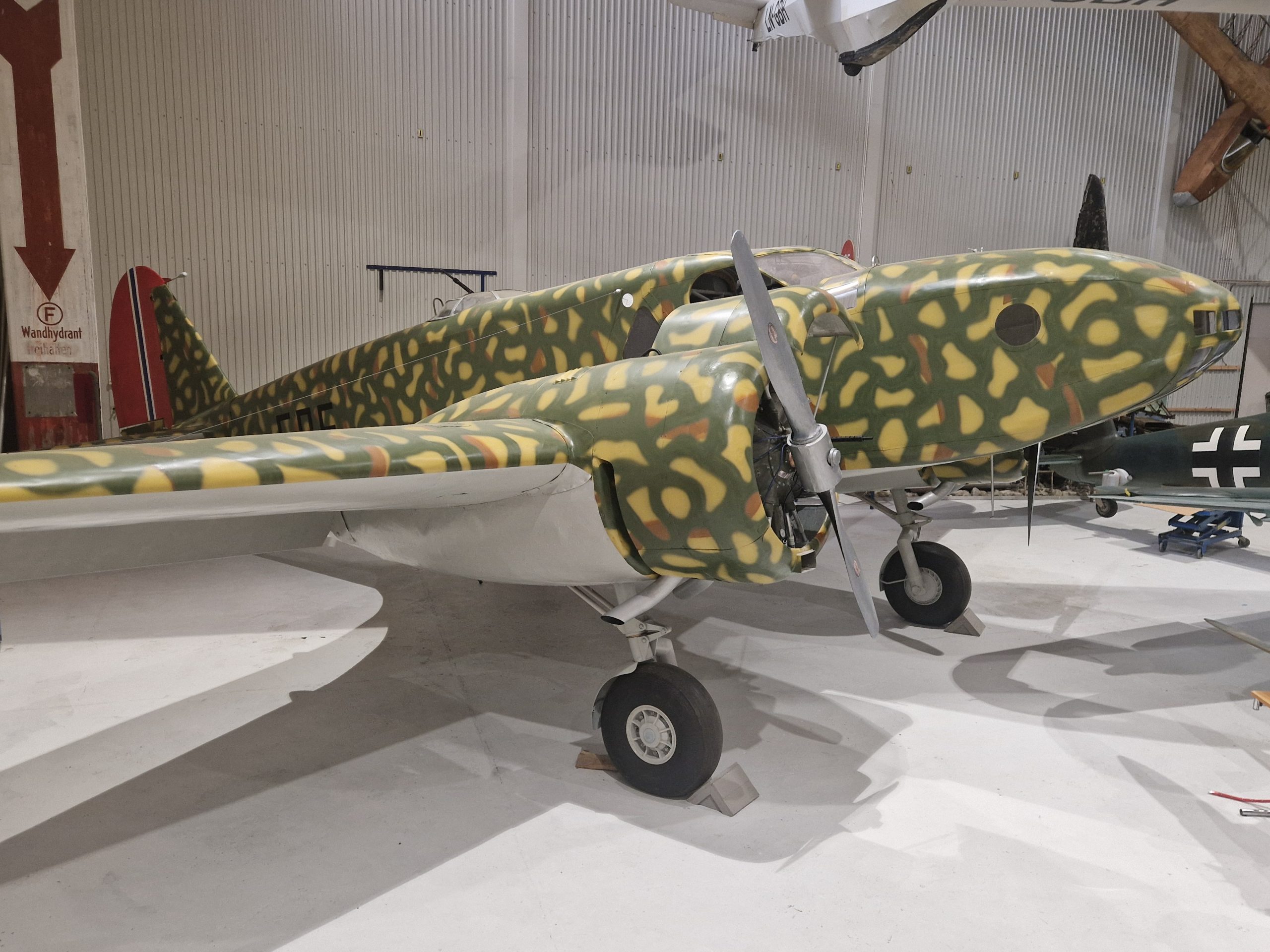
This is the only surviving Caproni Ca. 310 Libeccio in the world. The aircraft is a light twin-engine reconnaissance- and bomber aircraft. It was produced by the Italian aircraft manufacturer Aeroplani Caproni S.A. The aircraft made its first flight in 1937.
In the autumn of 1938, the Norwegian Army Air Force purchased four Caproni Ca. 310. The aircraft was a low-wing monoplane, with two engines, retractable landing gear, and radio equipment. The Norwegian Army Air Force also arranged to start licensed production of ten aircraft of this type at Kjeller, outside Oslo, but the project was cancelled due to the outbreak of the war.
The Norwegian state paid for the aircraft with revenues from exports of dried and salted cod to Italy. The aircraft type was therefore nicknamed the “klippfisk bomber”. On paper, the aircraft were modern and impressive, but in reality they were unreliable. Already on the flight home to Norway, one of the aircraft had engine problems and had to make emergency landings, in both Germany and Denmark.
On the morning of 9 April 1940, all four Caproni aircraft were at Sola. The pilots were ordered to fly to Eastern Norway, but that was easier said than done. One aircraft had technical issues and remained in the hangar. Another sustained minor damage during take off, got airborne, but had to make an emergency landing shortly afterward at a field airstrip in the south of Jæren. The crew set it on fire. The third aircraft was damaged by German aircraft attacking the airfield and did not manage to take off.
The museum’s aircraft
This aircraft was the only one to escape. It eventually ended up on Vangsmjøse in Valdres on 17 April. The aircraft was camouflaged but discovered anyway and attacked by German bombs. When the crew tried to depart again, one of the engines failed. On 18 April, the Germans occupied Valdres. They seized the aircraft, removed the engines, and left it. Later, local people dismantled parts from the aircraft before the remains of the fuselage were hidden behind a garage.
The remains were rediscovered in 1981, and transported to Flyhistorisk Museum Sola in 1999. This marked the beginning of a comprehensive reconstruction project, which is based on the steel tubes forming the fuselage skeleton. Most of the aircraft is a reconstruction.
Spesifications
| Type | Light reconnaissance and bomber aircraft |
| First flight | 1937 |
| Length | 12,2 m |
| Wingspan | 16,4 m |
| Height | 3,5 m |
| Weight, empty and max | 2960 / 4110 kg |
| Engine | 2x Piaggio P.VII.C.16 |
| Power | 2x 430 hp |
| Top speed | 365 km/h |
| Range | 1600 km |
| Crew | 1x pilot, 1x co-pilot and gunner, 1x radio operator and bombardier |
| Armament | 2x 7,7 mm machine guns, 400 kg bombs |
| Country of origin | Italy |
| Number used by the Armed Forces | 4 |
| Service life in the Armed Forces | 1938–1940 |
| Museum number | FMSG2012.10.01 |
| Project leaders | Rasmus Svihus, Kjell Dahle, Siegfried Hernes, Harald Egge |
| Volunteer hours | 10 155 |