
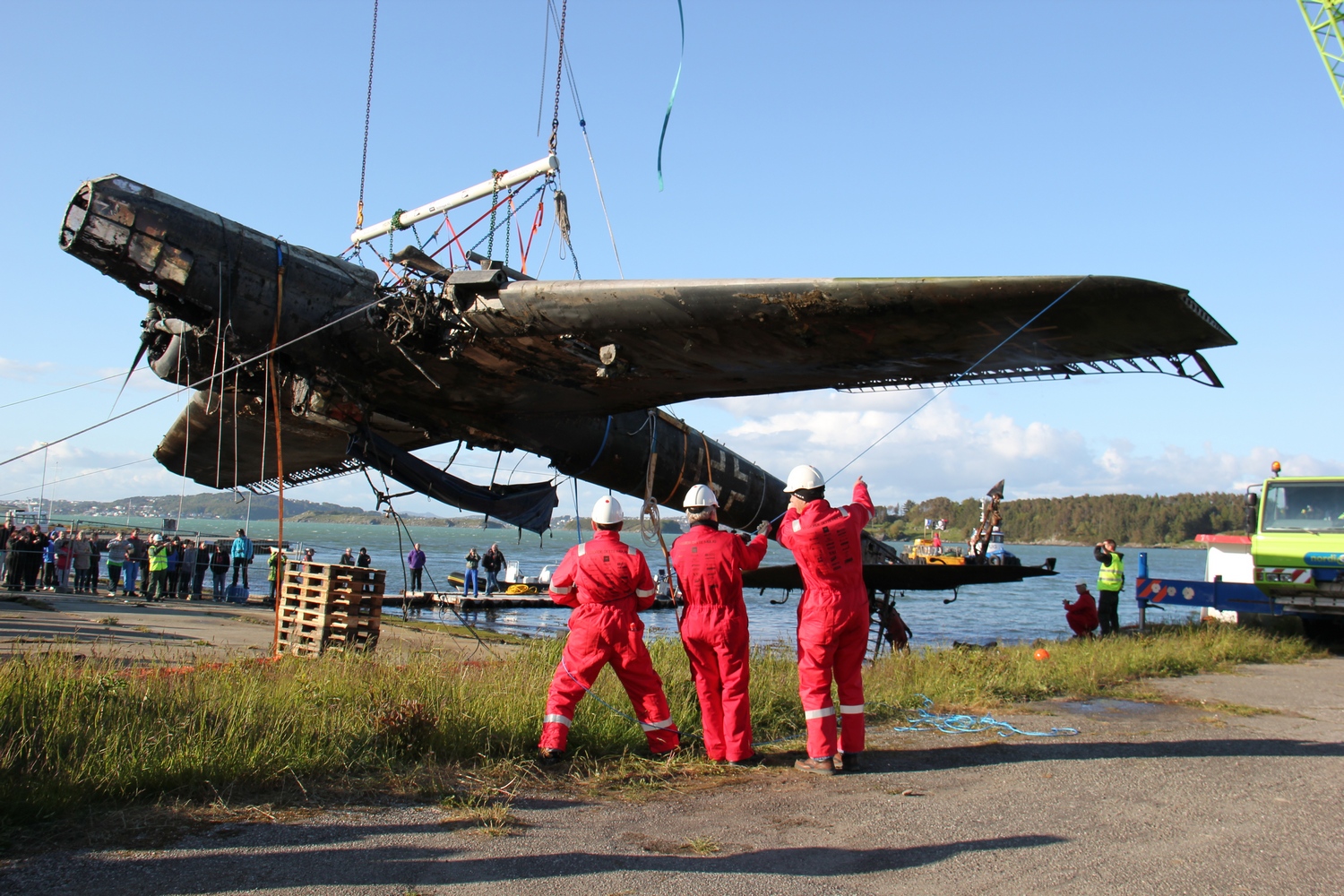
The Heinkel He 115 may not be the most graceful aircraft in the museum’s collection, yet visitors travel from far and wide to see it. This aircraft is the only preserved example in the world. It was discovered on the seabed of Hafrsfjord in 2005.
The Heinkel He 115 is a twin-engine maritime patrol and torpedo bomber. The type was introduced by the German Luftwaffe before the Second World War. It was developed in the 1930s and first flew in 1937, but had a relatively short operational career. Most aircraft were lost in combat or destroyed in other ways. After 1944, the type was no longer in German service and no effort was made to preserve it. This aircraft was found by chance when the Norwegian Mapping Authority was testing new sonar equipment in Hafrsfjord. The aircraft was raised by the museum’s Friends Association in 2012.
The Norwegian Naval Air Service purchased six aircraft of this type shortly before the outbreak of the war. They arrived in Norway in 1939. When German seaplanes landed at Sola Seaplane Base on the day of the invasion, 9 April 1940, they were moored alongside one of the Norwegian aircraft, which was captured by the Germans as war booty. During the war, several of the Norwegian aircraft were involved in combat against German forces. The Norwegians later captured two German aircraft of the same type during the fighting.
The total number of Heinkel He 115 produced is estimated to be 224. Of these, 140 were of the B-variant, like the museum’s example. During its service time, our aircraft was largely modified to C-version.
The museum’s aircraft
The museum’s aircraft was most likely completed in September 1939 and delivered to the Luftwaffe in October. It arrived in Norway in the autumn of 1942. In Norway it operated both from the coast of Finnmark and from Sola Seaplane Base. The German aircraft stationed at Sola Seaplane Base were used for transport, reconnaissance, medical evacuation, mine-laying, as well as bombing and torpedo attacks in the North Sea and along the British east coast.
The aircraft was wrecked on 28 December 1942 during a landing accident in poor weather. Just before the floats touched the water, the aircraft veered sharply to the left and struck the surface hard. It lost its left float and tipped onto its side before eventually sinking to the bottom of the fjord. There it came to rest upside down. The crewn escaped without injury. Before the aircraft sank, the Germans managed to salvage one of the two engines as well as both floats.
The museum’s exhibition hangar (the building you are now standing in) was built by the Germans early in the war. The hangar was used to house German seaplanes stationed at Sola Seaplane Base, including the Heinkel He 115.
Spesifications
| Type | Maritime patrol and torpedo bomber |
| First flight | 1937 |
| Length | 17,3 m |
| Wingspan | 22,2 m |
| Height | 6,6 m |
| Weight, empty and max | 5300 / 10 400 kg |
| Engines | 2x BMW 132 |
| Engine power | 2x 960 hp |
| Maximum speed | 315 km/h |
| Range | 2100 km |
| Crew | Pilot, radio operator/navigator, rear gunner |
| Armament | 4x 7.92 mm machine guns, 920 kg torpedo / bombs |
| Country of origin | Germany |
| Museum number | FMSG2013.01.001 |
| Project managers | Roar Henriksen, Stein Rosengren |
| Volunteer hours (as of 2025) | 21 718 |