In all wars, there is a need to transport soldiers, equipment, and supplies to and from the front line. At the same time, wounded soldiers must be brought to safety.
The Bell UH-1 was developed on commission for the U.S. Army. The helicopter is best known as the “Huey” and became an icon of American warfare during the Vietnam War (approx. 1962 1973). Series production began in 1960, and in March 1962 the first helicopters were sent to Vietnam. There they were used for virtually every kind of mission: evacuation of wounded personnel, search and rescue operations, reconnaissance, electronic warfare, ground attack, and transport of troops, equipment, and supplies. Nearly half of all UH-1 helicopters used during the Vietnam War were lost.
Norwegian service
From 1963 to 1965, twelve Bell UH-1B Iroquois helicopters were delivered to the Norwegian Armed Forces. They were provided as military aid from the United States and were stationed with 339 Squadron at Bardufoss. Here, the Armed Forces operated a dedicated helicopter squadron. 339 Squadron primarily flew missions for the Army, including tactical transport of troops and supplies, evacuation of sick and wounded personnel, border patrol flights toward the Soviet Union, as well as Standing Alert Duties.
The squadron also carried out many missions in support of the civilian society, such as ambulance and rescue operations, and lifting and transport tasks for counties, municipalities, and private businesses. This made 339 Squadron a well-liked unit. During the helicopter’s service with 339 Squadron, at least two children were born on board such helicopters.
In addition to the twelve helicopters delivered through the U.S. military aid program, the Armed Forces purchased 25 used Bell UH-1 from the United States. With these, a new helicopter squadron was established in southern Norway, 720 Squadron at Rygge, as well as 719 Squadron in Bodø, which operated a mixed flight of light transport aircraft and helicopters.
The museum’s aircraft
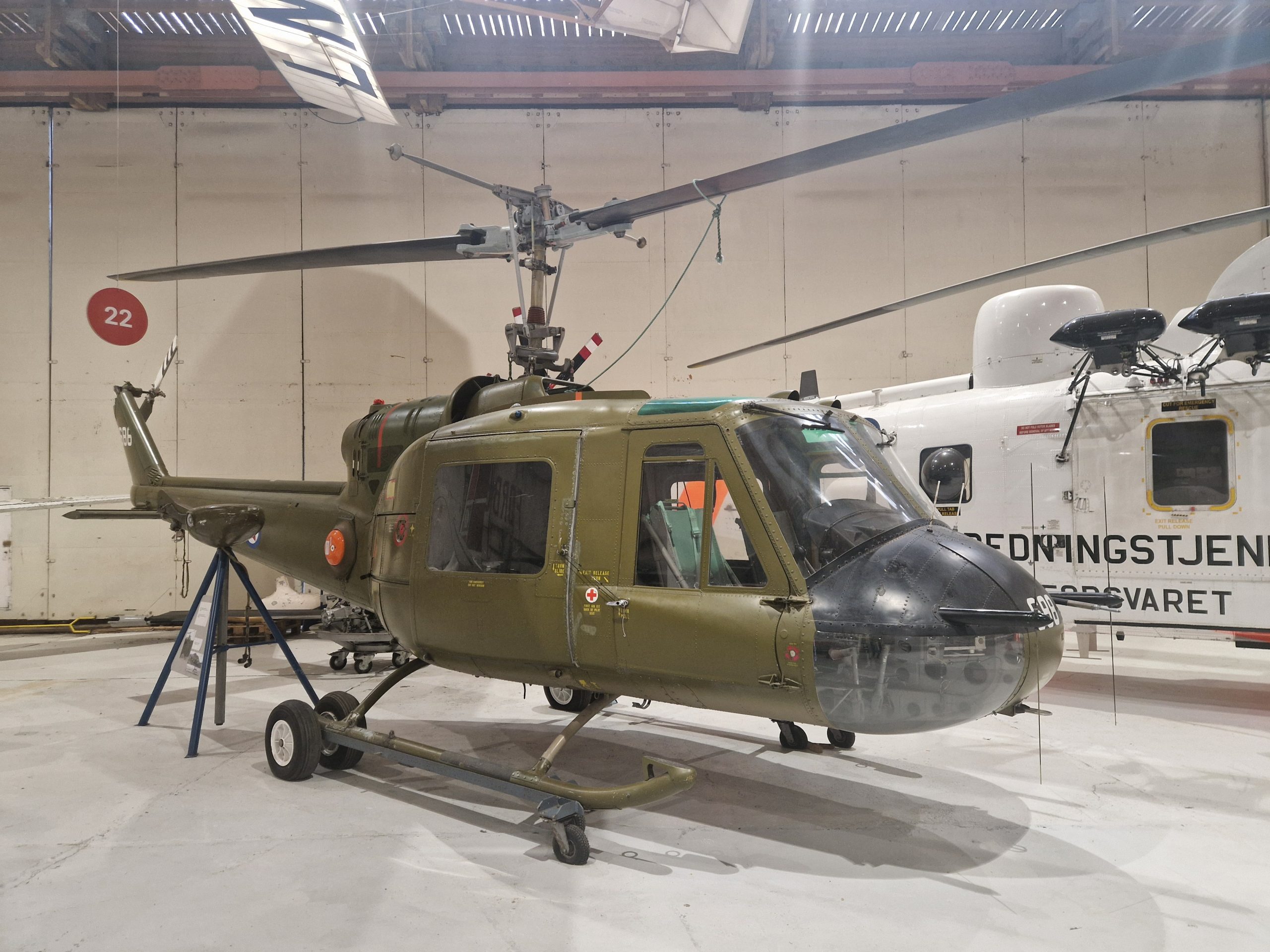
The museum’s helicopter is one of eight Bell UH-1B Iroquois received by the Royal Norwegian Air Force in 1970. It served with 720 Squadron until 1990. The helicopter made history in 1974 when it landed on the frigate KNM Stavanger. This was the first time a Norwegian military helicopter landed on a Norwegian naval vessel.
After being withdrawn from service in 1990, the helicopter was first used in exercises for soldiers conducting dry training in boarding and disembarking helicopters at Vatneleiren in Sandnes. It was later transferred to Flyhistorisk Museum Sola as a long-term loan from The Norwegian Armed Forces Museum.
Spesifications
| Type | Military transport helicopter |
| First flight | 1956 |
| Length | 12,1 m |
| Rotor diameter | 13,4 m |
| Height | 4,5 m |
| Weight, empty and max | 1980 / 3860 kg |
| Engine | Lycoming T-53-L-9A |
| Power output | 1100 hp |
| Top speed | 240 km/h |
| Range | 600 km |
| Crew | 1x pilot, 1x mechanic |
| Passenger capacity | 5 |
| Country of origin | USA |
| Number used by the Armed Forces | 37 |
| Service life in the Armed Forces | 1963–1991 |
| Museum number | FMSG2012.04.01 |