
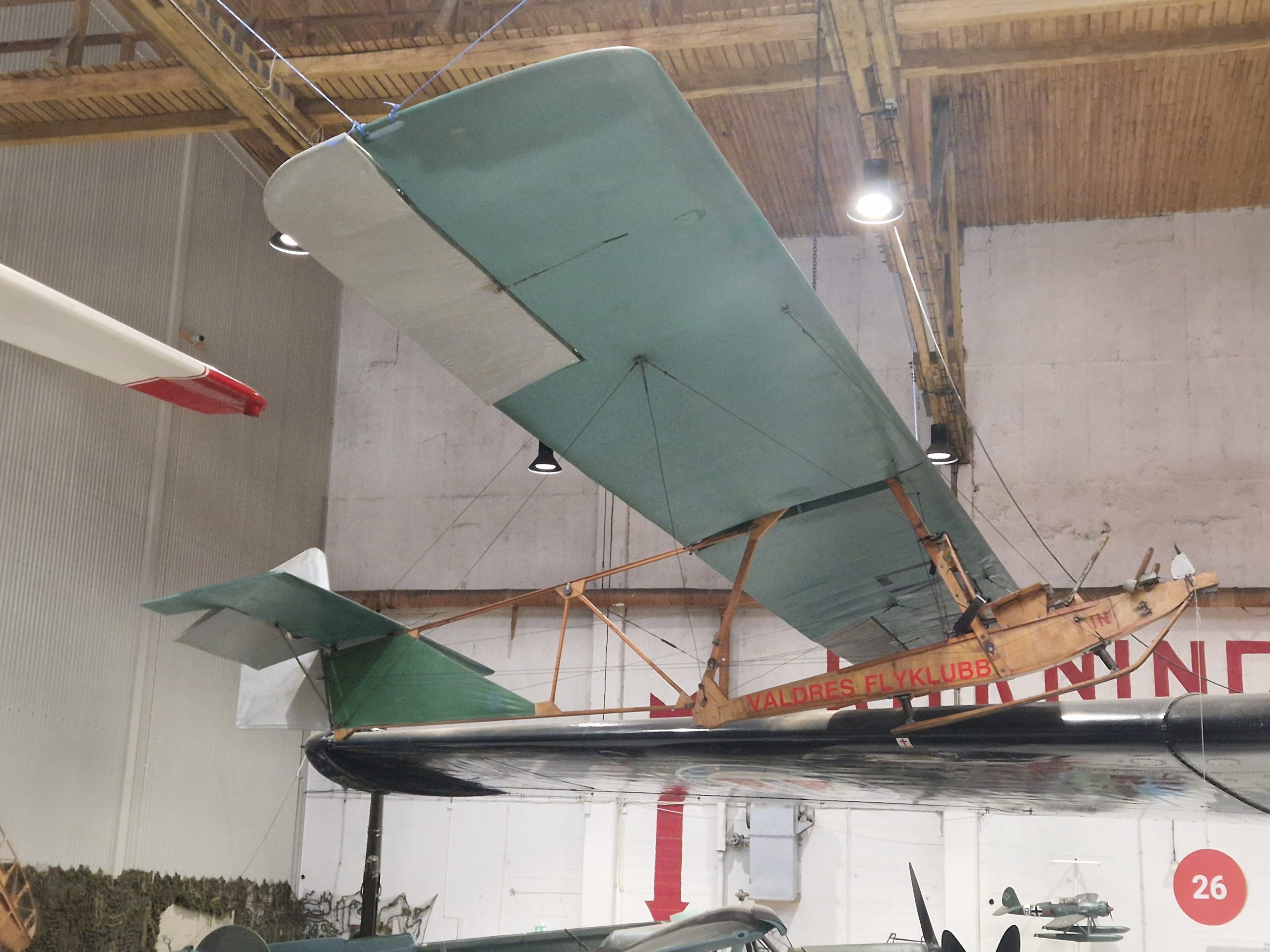
The DFS SG 38 Schulgleiter is a German glider that was developed shortly before the Second World War. During the war, it was widely used as a training aircraft by the Nationalsozialistisches Fliegerkorps (NSFK). Many German pilots gained their first flying experience in this simple design.
The wings consist of a wooden structure partially covered with aircraft fabric covering. The pilot sits on a simple seat just in front of the wing and controls the aircraft using two pedals and a simple control stick.
To learn how to fly, students first trained on the ground. They would slide across a grassy field while trying to keep the aircraft level without letting the wings scrape the ground. The next step was to practise lifting to a height of a few metres, before gradually climbing higher and higher. After that, they progressed to airborne flight, where they learned turning techniques. The aircraft took off either by bungee launch from slopes, by winch, or by tow car on large, flat fields. In Norway, frozen lakes have been well suited as runways for gliders.
Simple aircraft like this one are known as gliders. These are different from sailplanes, which are far more advanced. The DFS SG 38 Schulgleiter was one of the last aircraft of its kind. It differed from its predecessors, such as Hols der Teufel, in that it had a sprung undercarriage. This reduced the risk of back injuries during hard landings. Aircraft of this type continued to be used as training aircraft well after the Second World War.
The museum’s aircraft
This aircraft was built during the Second World War by members of the Swedish aero club Örebro Läns Automobil og Flygklubb. The aircraft carried out its first test flight on 14 June 1943. In that same year, it completed a total of 467 flights, amounting to five hours, 18 minutes and 46 seconds. In 1956, the aircraft was sold to the Norwegian aero club Valdres Flyklubb. It was removed from the Norwegian Aircraft Register in 1972. It was later displayed at the Norwegian Museum of Science and Technology in Oslo. For a period, it was also suspended from the ceiling at Amfi Leira shopping centre before being donated to the museum in 2024.
Spesifications
| Type | Single-seat glider |
| First flight | 1938 |
| Length | 6,3 m |
| Wingspan | 10,4 m |
| Height | 2,4 m |
| Weight, empty and max | 100 / 210 kg |
| Top speed | 115 km/h |
| Country of origin | Germany |
| Museum number | FMSG2025.011.01 |