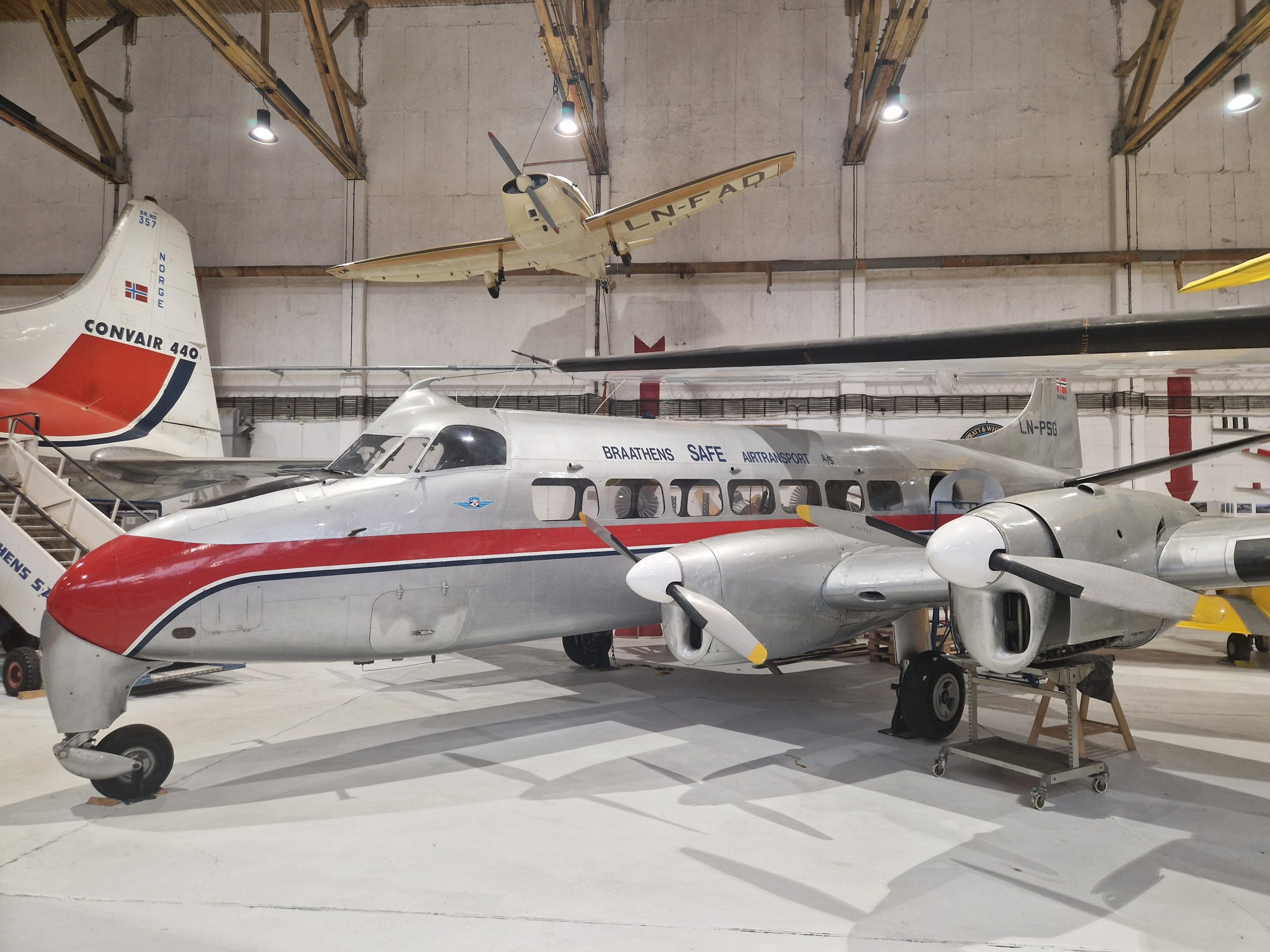
The de Havilland DH.114 Heron is a British passenger aircraft from 1950. The aircraft could carry 17 passengers and was designed for short-haul operations. It is a further development of the de Havilland DH.104 Dove from 1945. Compared to its predecessor, the de Havilland DH.114 has a slightly longer fuselage and four engines instead of two.
The first version of the aircraft had fixed landing gear, meaning that the wheels could not be retracted into the fuselage. Later versions were fitted with retractable landing gear. The cruise speed was relatively low, but the aircraft was robust and well suited for operations from unpaved airstrips. Despite a total production run of only 149 aircraft, the Heron was exported to around 30 countries.
Norwegian service
In Norway, the aircraft type was operated by four airlines: Braathens SAFE, Vestlandske Luftfartsselskap, Nor Flyselskap AS, and Fjellfly. Braathens SAFE was among the first airlines to introduce the type. The company purchased six aircraft and became one of the world’s largest operators of the Heron.
Braathens SAFE was established by shipowner Ludvig G. Braathen in 1946. Many of the company’s ships operated between ports in Asia and South America, and changing crews was difficult. The solution was to establish an airline that could transport seafarers between Norway and the shipping company’s ports of call in distant regions. SAFE was an abbreviation for South American and Far East Air Transport. In 1954, SAS was granted a monopoly on international routes, and Braathens SAFE was forced to discontinue its long-haul services. The shipowner nevertheless wished to continue his aviation venture, and the solution was to focus on domestic routes instead. It was at this point that the Heron aircraft were purchased.
The aircraft were not pressurised and typically flew at altitudes between two and three thousand metres. They had modest requirements for runways and other infrastructure. Their versatility led to the aircraft becoming known as “the air bus”. Braathens SAFE’s domestic routes proved highly successful, and the de Havilland aircraft soon became too small. By the late 1950s, they were replaced by the Fokker F.27 Friendship.
The museum’s aircraft
The museum’s aircraft dates from 1953 and belongs to the first production series without retractable landing gear. Its first owner was Garuda Indonesian Airways, which used the aircraft on routes between Jakarta and major cities and islands in Indonesia. After three years, the aircraft was sold to Field Aircraft Service in England. From 1957 it was operated by Morten Air Service. In 1972 it was purchased by Fjellfly, but the company went bankrupt shortly thereafter. In the mid-1980s, the aircraft was acquired by Flyhistorisk Museum Sola, becoming the museum’s very first aircraft. The aircraft was restored, painted in Braathens SAFE livery, and given the registration LN-PSG. It represents the aircraft with serial number 14002, which was operated by Braathens SAFE between 1952 and 1957.
Spesifications
| Type | Short-haul passenger aircraft |
| First flight | 1950 |
| Length | 14.8 m |
| Wingspan | 21.8 m |
| Height | 4.8 m |
| Weight, empty and max | 3700 / 6100 kg |
| Engines | 4x de Havilland Gipsy Queen 30 Mk.2 |
| Power | 4x 250 hp |
| Top speed | 295 km/h |
| Range | 1475 km |
| Crew | 2x pilot |
| Passenger capacity | 17 |
| Country of origin | United Kingdom |
| Museum number | FMSG2010.10.01 |
| Project leader | Harald Storli, Kjell Naas |
| Volunteer hours | 1136 |