
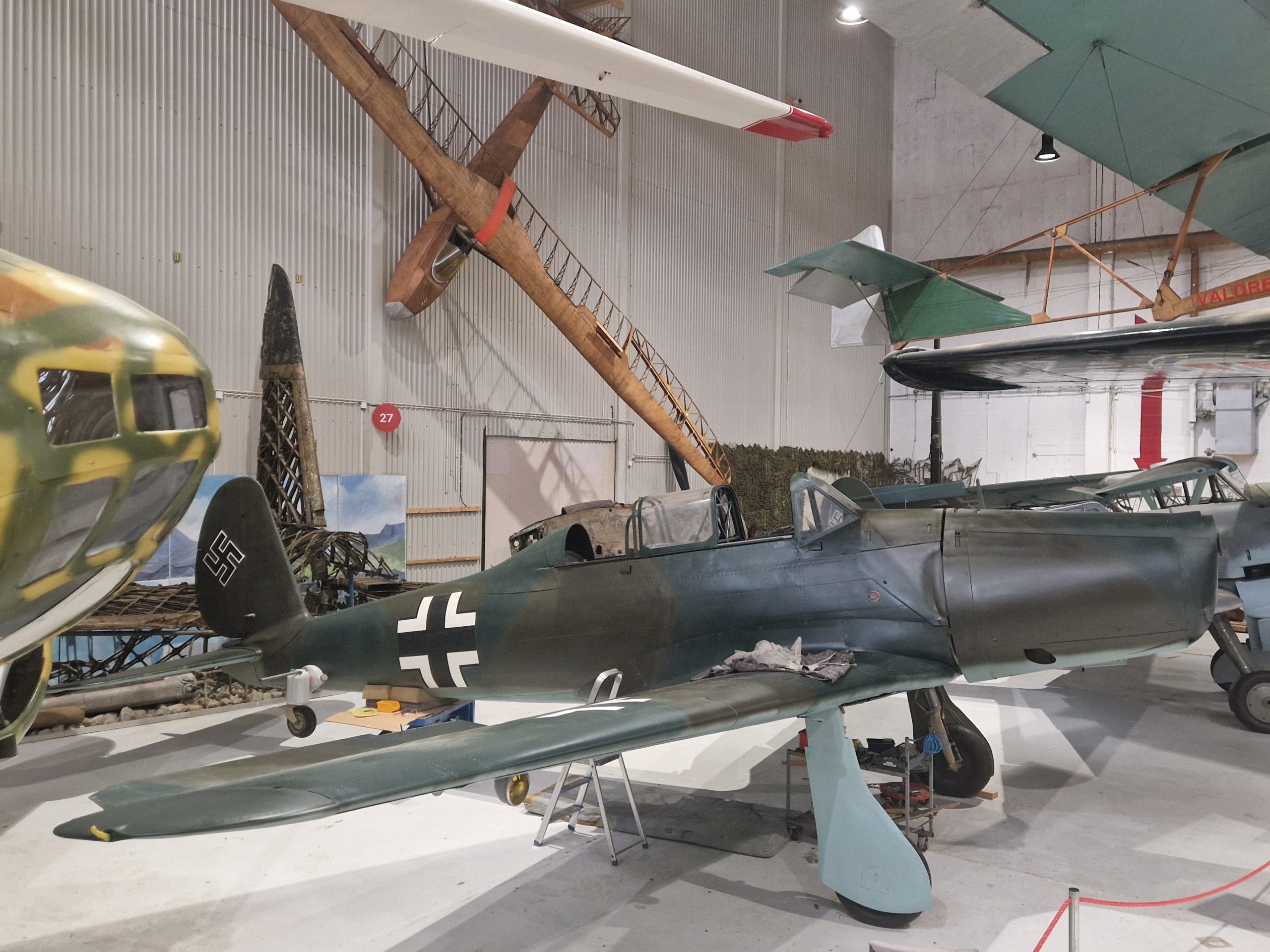
The Arado Ar 96 was Germany’s standard advanced trainer for future fighter pilots throughout the Second World War. It was particularly well suited for training in night flying, aerobatics, in-flight radio communication, and instrument flying.
The aircraft were also used in a support role for operational units, transporting important personnel and dropping small bombs at the front line. In addition, the aircraft were used for reconnaissance.
The aircraft carried out its first flight in 1937. bIn the autumn of 1939, it was taken into service at German flight schools. It wa produced in several versions, with a total production close to 2900 aircraft. Initially, the aircraft were produced by Arado Flugzeugwerke in Germany. Later, production was moved to Czechoslovakia, where the aircraft was given the designation Avia C-2B.
The museum’s aircraft
The museum’s aircraft is an unarmed Arado Ar 96B-1. Among other locations, it was stationed at Herdla outside Bergen. On 13 March 1943 it crashed while en route from Herdla to Sola. Above Bømlo it suffered engine trouble. The pilot, Fritz Mühlberger, managed to make an emergency landing on Lake Storavatnet near Bremnes. Mühlberger survived, but was later shot down and killed while flying a Focke Wulf Fw 58 Weihe.
The aircraft was salvaged in 1992. It had been submerged for nearly 50 years with its nose buried in mud. Apart from wheels, engine, cowling, various fairings, and the canopy, the aircraft was complete and nearly intact. Despite this, the restoration required extensive work. The aircraft was pressure-washed several times before most components were dismantled for further cleaning and restoration. After cleaning, the wings were sprayed internally with a penetrating fluid. The fuselage was stripped of parts and treated with paint remover before being primed. All instruments were present, but they were filled with water and partially corroded.
Parts of the aircraft have been rebuilt by members of the museum’s friends association, including the canopy, which was jettisoned when the pilot left the aircraft. The same applies to the wing leading edges at the wheel wells, which were damaged when the aircraft struck water.
Spesifications
| Type | Two-seat military training aircraft |
| First flight | 1937 |
| Length | 9,1 m |
| Wingspan | 11 m |
| Height | 2,6 m |
| Weight, empty and max | 1295 / 1700 kg |
| Engine | Argus As 410A-1 |
| Engine power | 465 hp |
| Maximum speed | 330 km/h |
| Range | 1000 km |
| Armament | None |
| Country of origin | Germany |
| Museum number | FMSG2011.13.01 |
| Project manager | Halvdan Krohn, Roar Henriksen, Kjell Naas |
| Volunteer hours, as of 2025 | 12. 010 |