
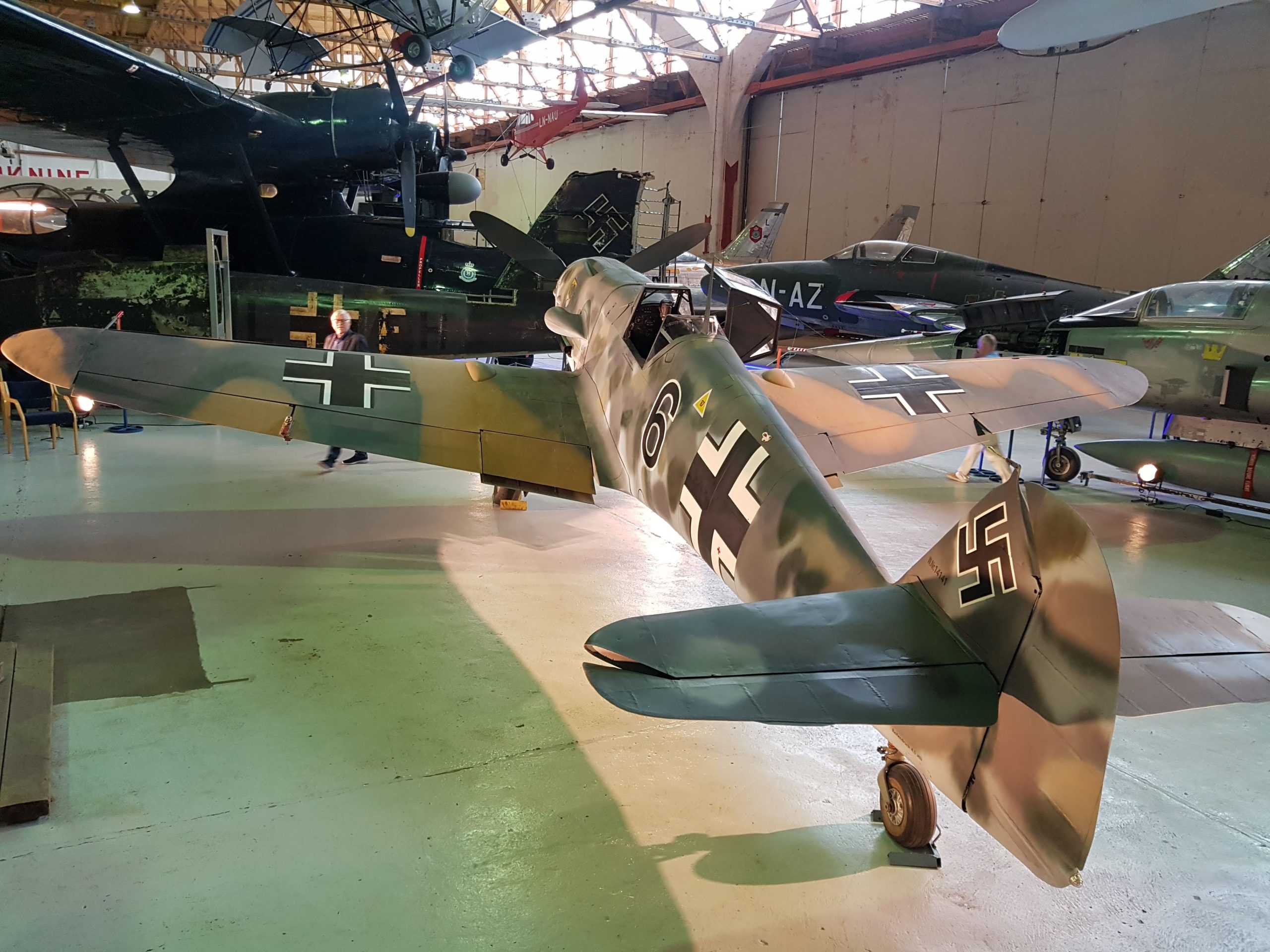
The Messerschmitt Bf 109 is regarded as one of the most influential fighter aircraft in aviation history. When the aircraft was introduced in the 1930s, open biplanes were still common. Messerschmitt Bf 109 was something entirely different: both the fuselage and wings were made of metal, it had low-mounted wings, retractable landing gear, an enclosed cockpit, a powerful engine and outstanding flight performance. It proved to be a deadly opponent for enemy aircraft that encountered it in countless aerial battles during the Second World War.
The museum aircraft crashed in 1943. It lay on the seabed off Egersund until 1988, when two fishermen hauled it up in their trawl. After tens of thousands of volunteer working hours, the aircraft now stands as one of the jewels of the museum’s collection.
The Messerschmitt Bf 109 is a good example of how the German war industry developed entirely new technology in the years leading up to the Second World War. Work on the aircraft began in the mid-1930s, when Ministry of Aviation (Nazi Germany) announced a competition for a new fighter aircraft. Bayerische Flugzeugwerke won the competition. The work was led by the company’s chief engineer, Willy Messerschmitt. In the summer of 1938 he was promoted to head of the company, which was then renamed Messerschmitt AG.
New and improved versions of the aircraft were introduced throughout the war, including new engines. The first engine was the Junkers Jumo 210D, producing about 650–670 hp. It was soon replaced by the liquid-cooled V-12 Daimler-Benz DB 601 and later a DB 605 engine, which eventually delivered nearly 1500 hp. Special versions were also produced with pressurised cockpits, like our aircraft.
The aircraft also had some weaknesses, including a relatively short range. It also had a tendency to tip over during take-off and landing on primitive airfields, as the landing gear wheels were positioned very close together.
In Norway, the Messerschmitt Bf 109 was used throughout the Second World War. Here at Sola, the aircraft protected the airfield and German shipping traffic off the coast of Jæren.
The museum’s aircraft
The museum’s aircraft was found by two shrimp fishermen off the coast of Sirevåg, in 1988. The aircraft got caught in their trawl, and the fishing boat was too small to bring the aircraft up unto the deck. Instead, the fishermen secured the wreck to the side of the hull and slowly headed back to land. The paint and markings on the upper surfaces of the wings were relatively well preserved, but otherwise the aircraft was badly damaged. Both the nose and tail sections were missing. At the museum, members were well underway with cleaning the wreck when they discovered a large number of live rounds of ammunition. Once these had been removed, restoration work continued and eventually exceeded 30 000 volunteer working hours.
Spesifications
| Type | Single-seat fighter aircraft |
| First flight | 1935 |
| Length | 9 m |
| Wingspan | 9,9 m |
| Height | 2,6 m |
| Weight, empty and max | 2250 / 3150 kg |
| Engine | Daimler-Benz DB 605 A-1 |
| Engine output | 1475 hp |
| Top speed | 640 km/h |
| Range | 700 km |
| Armament | 2x 7,92 mm machine guns, 1x 20 mm cannon |
| Country of origin | Germany |
| Museum number | FMSG2012.05.01 |
| Project manager | Kjell Naas |
| Volunteer hours | 30 626 |