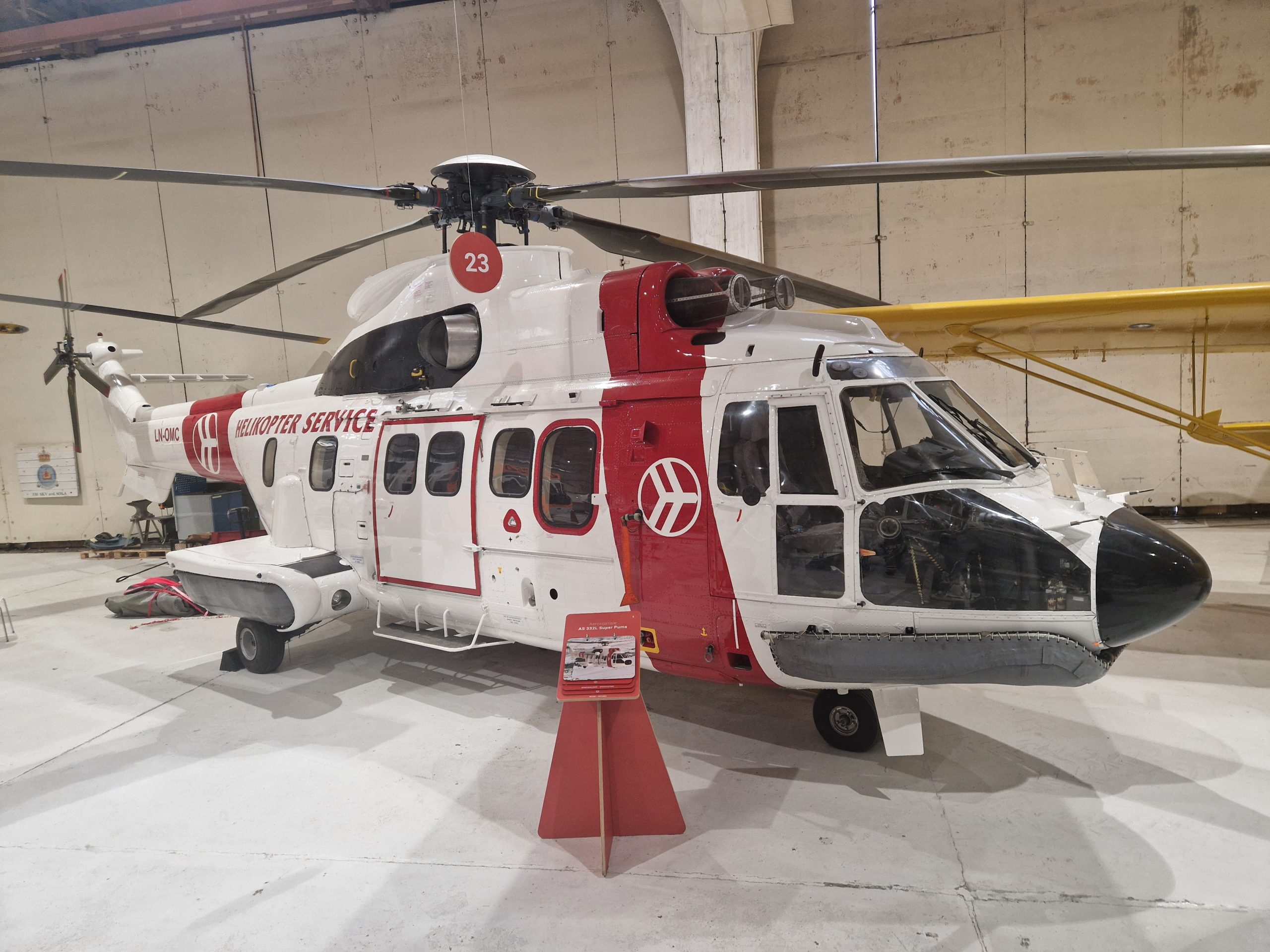
For several decades, Super Puma was one of the oil workers’ commuter buses. The helicopters flew shuttle traffic between offshore installations and land. Many oil workers will remember sitting down in the helicopter seat, fastening the safety belt, hearing the sounds penetrating through the ear defenders, the smell of the bulky survival suit, and the uneasy movements as the machine is tossed about in bad weather.
Helikopter Service purchased the first Super Pumas in 1983. Soon they operated a fleet of 13 such helicopters. Thus, Super Puma became one of the most common helicopters on the Norwegian continental shelf.
Aerospatiale AS 332L Super Puma is a medium-sized helicopter. It was developed in the late 1970s based on the Aerospatiale SA 330 Puma, a French military transport helicopter from the 1960s. The improved Super Puma proved so successful that it was put into military service in nearly 40 countries. It was also widely used by civilian operators. The helicopters were often modified for their intended use. As of 2026, the Super Puma was still in production.
The museum’s aircraft
This helicopter has a dramatic history involving one minor and two major accidents. The first occurred in March 1988, when it had to make an emergency landing on a Polish cargo vessel far out at sea, off the coast of Egersund. In June the same year, it crashed into the sea 80 nautical miles west of Sola. At the time, there were two pilots and 16 oil workers on board. No one suffered physical injuries, but the helicopter was so badly damaged that it was sent to the factory in France to be rebuilt. It was then converted into a rescue helicopter and later stationed on Svalbard. Here it crashed in 1996. The helicopter was on a training flight with seven people on board. While flying north, the crew spotted a polar bear and attempted to position themselves better to photograph it. After several sharp turns at low altitude and low speed, it lost height and struck the ground. Everyone on board survived.
The restoration of this helicopter was carried out using the tail section from another Super Puma registered LN-OBP which the museum acquired around the same time. The second helicopter had been salvaged after sinking to the bottom of the North Sea following an emergency landing in 1996. There were 18 people on board, all of whom survived. Students from the Aeronautical Engineering Program at Sola Upper Secondary School have contributed to the restoration work.
Spesifications
| Type | Offshore helicopter / All-Weather Search and Rescue |
| First flight | 1978 |
| Length | 18,7 m |
| Rotor diameter | 15,6 m |
| Height | 4,9 m |
| Weight, empty and max | 4660 / 9300 kg |
| Engine | 2x Turbomeca Makila 1A2 turboshaft |
| Engine power | 2x 1 755 hp |
| Maximum speed | 330 km/h |
| Range | 840 km |
| Crew | 2x pilot / 2x pilot, 1x rescue crewman, 2x hoist operator |
| Passenger capacity | 21 |
| Country of origin | France |
| Museum number | FMSG2025.008.01 |
| Project managers | Gordon Bore, Roar Ingebrethsen |
| Volunteer hours (per 2025) | 10.818 |